2026-09-23
It is not certain that your 10-year-plus-old boiler must be replaced, as this varies according to its model and maintenance. In most cases, a few strategic upgrades could put the equipment back on par, update it to present times, or keep that equipment in service and extended. Boiler repair and maintenance can also help extend equipment life and identify whether specific components require repair or replacement. There will be cases where investing further in an old boiler may not make any more sense.
With facility owners being able to compare the equipment situation with these aspects, efficiency, state, safety, operating demands, time, and expense, deciding between boiler upgradation vs. boiler replacement becomes easier. With appropriate technical appraisal, it will also be apparent if only some parts would benefit from adjustment or replacement, as it is better value to replace everything.
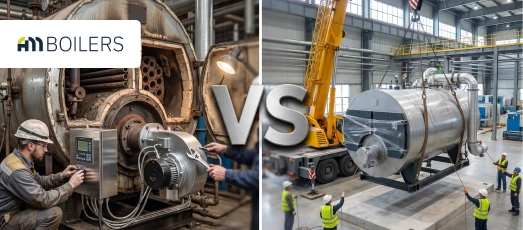
Boiler upgradation consists of modification or refurbishment of certain component parts of an existing boiler system, with the main part left as is as long as its condition is acceptable. The modification or upgradation is required to improve certain aspects of the boiler such as performance, reliability, safety, or control. Depending on the equipment and operating conditions, an upgrade may include:
The target should be determined by the results of an inspection, not by a general switch of obsolete equipment. In an industrial boiler upgrade, it is more feasible if the primary boiler structure is not affected by deterioration.
In addition to this, scheduled maintenance can help us find deterioration that will occur before it actually does.
Boiler replacement entails the removal of the boiler presently in place and the installation of a new one utilizing specifications for contemporary capacity, fuel utilization, efficiency, safety, and operation. The process is generally evaluated as needed once it would be uneconomical to continue modifying the present machinery extensively.
Replacement could be an option if pressure part integrity or mechanical components are extensively degrading; unit failure trends are increasing; if the boiler is not being operated effectively at the required capacity; or if there has been a notable change in facility output needs. Custom boiler fabrication services may also be considered when the replacement requires components or configurations tailored to the facility's specific operating requirements.
A more practical choice when considering industrial boiler replacement might be due to the inapplicability of modern controls, combustion systems, fueling arrangements, or other plant needs, without excessive modification.
Selection of a replacement just because of a boiler's age would be inappropriate. The physical state of the boiler, its previous usage history, and the cost of maintenance, together with future needs, should be assessed.
However, not only is price the choice of renewal or modernization. It is also a matter of the old one's health condition, expected operational lifespan, performance, and need for installation and production plans.
| Factor | Boiler Upgradation | Boiler Replacement |
|---|---|---|
| Existing equipment | Retains suitable major components | Existing boiler is removed |
| Scope | Targeted modifications or retrofits | Complete equipment change |
| Initial investment | Often lower, depending on scope | Usually higher |
| Downtime | May be more limited | Usually requires greater planning |
| Efficiency improvement | Depends on selected upgrades | New equipment may offer broader improvements |
| Service life | Extends useful life of existing equipment | Provides a new operating life |
| Compatibility | Must integrate with existing systems | Designed as a new system |
| Suitable for | Sound boilers with upgrade potential | Boilers with major deterioration or inadequate capacity |
An industrial boiler upgrade is a good option when you have a structurally safe boiler that may need updated controls, poorer combustion efficiency, or damaged insulation. When it comes to critical structural issues with the boiler itself and a unit of improper size, it would probably be cheaper to replace it.
Understanding when to upgrade boiler equipment requires looking at operating performance rather than relying only on its age. The increased rate of fuel usage, dropping levels in performance, aging controls, repeated component failure, and growing demand on the maintenance department can all suggest it is time for an upgrade.
A modernization may be required when the principal pressure parts and the structure are otherwise acceptable, but specific systems do not work as efficiently as required. This may take the form of improving the burners, controls, instrumentation, insulation, or using heat recovery in new ways without replacing the whole unit. Refractory and insulation services in UAE can also help address damaged insulation or refractory that may contribute to heat loss and reduced boiler performance.
In contrast, knowing when to replace a boiler requires considering whether the existing equipment can realistically meet future operating requirements. Replacement might be more economical when very severe corrosion, recurrent pressure part failures and degradation, considerable structural damage, capacity limitations, or high repair costs are evident.
Thus, operating data, maintenance records, and required lifetime as well as future capacity requirements based on condition survey analysis must form the basis of this decision.
Facility operators should consider the following points before deciding on one of the above methods. These are some important questions that may help decide which option will be better for the future operation of the boiler and the present conditions. Smart choices now will avoid unnecessary expenses later.
Check the pressure vessel, tubes, furnace, refractory, insulation, valves, and so on. The condition of the structures is one of the major factors that you should not neglect when deciding whether to renovate the equipment to make it upgradeable.
Observe steam production, fuel use, operational stability, heat losses, and a history of maintenance. Through this, you may learn whether the problem is specific to certain components or to the boiler in general.
Also, ask whether the amount of production is likely to increase. If the current boiler isn't adequate for a future need, then a replacement may not offer as much flexibility as retrofitting the current unit.
Safety equipment controls, pressure parts, combustion systems, and similar apparatus are all required to be judged in terms of their relative capabilities compared to both requirements and operating conditions.
Ensure that the proposed new burners, controls, instrumentation, and associated ancillaries are compatible with the existing boiler. This compatibility needs to be verified prior to confirming the extent of the upgrade package.
The purchase price, installation, and commissioning costs, together with any associated infrastructure changes for a replacement. Compare the costs of proposed modifications with these costs.
Think about the amount of production downtime the plant is capable of tolerating. An upgrade focused on one specific thing can sometimes be done within a more manageable shutdown.
Evaluate whether the proposed modifications and potential improvements can provide a tangible increase in efficiency under real operating conditions of load conditions, fuel used, boiler condition, and operating practices.
Although it may appear it would be uneconomical to continue to run the current boiler when problems persist and occur more frequently, and maintenance costs are higher than ever.
Look at the expected running time of the boiler and whether there will be any fluctuations in demand. Short- to medium-term needs might justify an upgrade. Long-term expansion might dictate a replacement.
For facilities reviewing maintenance trends, boiler repair and maintenance can help address existing defects and provide useful information about component condition before a major capital decision is made. An industrial boiler maintenance checklist can also help teams track recurring issues, inspection points, and maintenance requirements over time.
Carefully planned retrofit projects can achieve some of the benefits listed by addressing specific weaknesses and losses of the existing boiler without replacing the entire boiler. Upgrading to burner systems will promote better control, while enhanced controls improve the ability of the operators to hold parameters steady.
Economizers and other heat recovery systems can further extract beneficial heat from the flue gases. Broken insulation and fractured refractory should be replaced. Controls improve the level of consistent control maintained for the firing rates, pressure, fuel-air ratio, and so on.
The level of savings is not fixed, as it varies depending on fuel, the existing boiler's condition, load, and the type of retrofits performed.
As there will be multiple factors, not only cost but also age, to consider before deciding, it's worth checking that only these practical factors have come to light and not that an actual higher cost would arise with one boiler or the other. Reviewing these factors can also help operators avoid unnecessary investment and plan the project with greater confidence. Before making the final decision, facility operators should ask:
Upgrades should be considered if the main structure appears stable, with the most likely issues being component-dependent. If large amounts of depreciation or fundamental capacity problems are discovered, replacement may be the most sound value for the long term.
A professional appraisal decreases the chances of selecting an option simply on boiler age or a low, upfront cost. Engineers have the capability to identify potentially problematic systems, thoroughly examine all major components, and review past operating data and recurring issues.
The component interface needs to be addressed. Replacing the controls without considering whether the existing burner, instrumentation, fuel system, and ancillary equipment were compatible with a new control package often leads to complications.
A full appraisal will verify if retrofitting or replacement, rather than simply repair or upgrade, is the most sound solution. This will offer an objective method for decision-making and investment in plant equipment.
For ongoing reliability, professional boiler maintenance services can also help maintain equipment after an upgrade or replacement and provide useful operating information for future assessments.
Al Mufaddal Boiler is engaged in providing boiler inspection, repairs, maintenance, fabrication, and refractory/insulation works. It offers its own boiler workshop facility in Dubai for the repair, manufacture, pressure parts fabrication, and maintenance, as well as for all boiler-related engineering works in marine or industrial environments, including economizers.
The company is positioned to undertake boiler work after performing its technical evaluation and outlining the necessary works. It then identifies and applies upgrade/replacement possibilities when and if necessary, based on present boiler conditions and the operating needs of the installation.
For UAE industrial facilities, this wider capability allows boiler upgradation vs boiler replacement to be evaluated as part of a longer-term reliability strategy. Instead of taking the "repair or replace" approach, you can make decisions based on the state of the equipment, operational needs, security, availability, and value through its lifespan.

Boiler upgradation consists of modification or refurbishment of certain component parts of an existing boiler system, with the main part left as is as long as its condition is acceptable. The modification or upgradation is required to improve certain aspects of the boiler such as performance, reliability, safety, or control. Boiler repair and maintenance can also help identify components that require attention before deciding whether an upgrade is appropriate.

