2026-06-19
It's no good relying on the boiler that is functioning perfectly today, but can fail in the future. Every properly functioning boiler is backed up by a maintenance programme - a system of tests and procedures that are conducted at predetermined intervals to maintain the system's functionality as intended.
For those UAE industries involved in oil and gas, petrochemicals, power generation, desalination, and manufacturing, the risks associated with boiler downtime are immense.Production timetables, safety responsibilities, and regulatory compliance are all contingent on boiler reliability. A planned boiler maintenance checklist is key to providing that boiler reliability.
This guide explores what should be included on an effective industrial boiler maintenance checklist, at the daily, monthly, and annual intervals respectively. It addresses the warning signs that mean a boiler needs maintenance earlier than scheduled, the errors that most often sabotage a maintenance plan, and what is unique about the UAE industry.
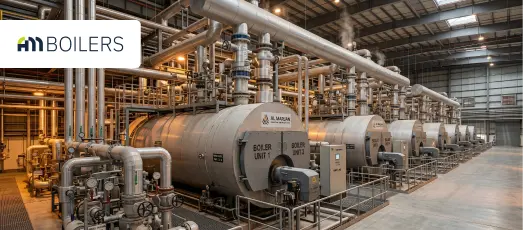
Boiler maintenance isn't something you do as an added safety precaution, but rather the deciding factor in having your boiler working well and safely, instead of it breaking down at the most inconvenient time.
Tube scale build-up is one of the most obvious, directly quantifiable killers of efficiency on any boiler. Even 1mm of scale results in a 5-8% drop in heat transfer efficiency, which in turn will mean your burner must run for an increased amount of time in order to produce the same amount of steam.
Simply keeping heat transfer surfaces and combustion clean and efficient will immediately lower fuel usage.
It is usually possible to detect warning symptoms before a boiler fails-this may include an increase in fuel consumption, repeated alarms, a fall or rise in pressure, or the presence of scale deposits.
An effective maintenance routine can detect these symptoms and transfer them from potential failure points into pre-scheduled work orders.
A boiler with a bad safety valve, a blocked flue, or a damaged refractory is a real danger to safety. Incidents involving pressure in industrial premises are serious.
Ensuring that safety devices are tested, certificated, and that the boiler remains operating within its design limits are mandatory on both ethical grounds and under UAE regulations concerning pressure vessels.
Corrosion and erosion are not fast processes. Identifying and tackling them during routine work - for instance, by detecting thin walls via Ultrasonic testing, dealing with the external corrosion before the casing fails, and repairing/replacing the burner elements before further damage is induced- results in a longer working life of the boiler.
Learn More: How Often Should A Boiler Be Serviced in the UAE?
A boiler preventive maintenance checklist is a formal documented record that lists: what to do, when it needs to be done, who the designated personnel are, and the record of when it was done. It is the workhorse of a maintenance program.
The distinction between reactive and preventive maintenance is simple. Reactive is carrying out work after failure has already occurred. Preventive maintenance is having scheduled work performed before failures occur.
There is a substantial difference in cost in the context of the boiler. The cost of scheduled replacement tubes found during inspection will be only a fraction of the cost of unplanned emergency replacement of tubes due to failure during operation.
Learn More: What Does a Boiler Service Include? Industrial & Marine Boiler Guide
These checks are performed daily by engineers or operators of the plant. They are simple to perform, taking 20 to 30 minutes, and form the first line of defense against a problem.
All the values for pressure, temperature, water level, fuel usage, and deviations should be recorded in the daily logbook. The daily logbook serves the purpose of both meeting regulatory requirements and trend monitoring. A steady increase in fuel usage, for example, would not become apparent unless readings are consistently taken over a period of time.
| Task | Frequency | Status |
|---|---|---|
| Water level check | Daily | |
| Pressure monitoring | Daily | |
| Leak inspection | Daily | |
| Burner inspection | Daily | |
| Blowdown operation | Daily |
These are the checks that go unnoticed during daily rounds. Monthly checks go more in-depth than daily rounds and require an experienced engineer or senior technician.
Lift each safety valve by hand to verify that the valve opens and reseats without hanging. Examine the valve body and seat for corrosion, wear, or leakage. Any safety valve that does not lift during a test must be attended to promptly.
Verify that test pressure switches, temperature sensors, and high and low water level controls operate as specified. Ensure that the automatic shutdown functions operate at the set points. Examine the fault log of the automation system to see if any faults have been registered since the last test.
Test the water fully for pH, TDS, dissolved oxygen, chloride and hardness. Compare against the parameters outlined for the specific treatment regime and modify the dosage as required.
Test combustion efficiency with a flue gas analysis and ensure the air-to-fuel ratio is correct. A fall in combustion efficiency compared to last month's test reading would suggest burner wear or fouling.
Examine the control panel wiring for any evidence of overheating, loose wiring, or corrosion, especially important in humid UAE coastal regions. Check all indicators, displays, and control outputs are operational.
Inspect the feedwater pump and motor for adequate lubrication, alignment, and vibration. High vibration is the first indication of a worn bearing or damaged impeller.
| Task | Frequency | Status |
|---|---|---|
| Safety valve inspection | Monthly | |
| Water quality testing | Monthly | |
| Electrical inspection | Monthly | |
| Combustion analysis | Monthly | |
| Pump inspection | Monthly |
An annual boiler service is a structured inspection carried out once every year by a qualified engineer to ensure that the system is operating safely, efficiently, and within expected performance levels. For industrial boilers in the UAE, this meets the requirements of regulation by the authority concerned, as per authority standards. This is the phase where a service engineer must be involved.
Access the boiler drum to view the condition of the tube surfaces, the tube sheets, the baffles, the interior deposits, etc. Record the conditions of all visible internal surfaces, reporting scale thickness or amount of corrosion.
Examine the condition of the tube surfaces, tube sheets, baffles, and the nature of the deposits within the drum. Record the condition of all the accessible internal surfaces. Note the degree of any corrosion, pitting, or scale that was not being removed by the water treatment regime.
Ultrasonic thickness testing of boiler tubes and drum shell to check for wall thinning due to internal/external corrosion. It's the only method by which corrosion that is not visible from the surface can be detected.
A comprehensive structural integrity check of the pressure vessel shell, heads, and nozzles is carried out in order to verify design against the design specification and relevant UAE pressure vessel code.
Pressure gauge calibration against a certified reference; temperature sensor calibration/verification; safety valve bench test and re-certification - all these calibration records should be retained.
Examine the flue and chimney for blockages, internal corrosion, and integrity. Ensure that the draft is correct. Lack of adequate draft results in poor combustion, and also flue gases may re-enter the building.
A complete burner overhaul includes replacing the nozzle, igniter electrode, checking and testing the flame detector, inspecting combustion head. Check the fuel line for corrosion, joint condition, and filter condition.
| Task | Frequency | Status |
|---|---|---|
| Internal inspection | Annually | |
| Boiler cleaning | Annually | |
| NDT testing | Annually | |
| Burner overhaul | Annually | |
| Safety calibration | Annually |
Learn More: Why Is Annual Boiler Service Important?
Whether your boiler is at the beginning or end of its life, these conditions demand an unscheduled service:
Kettling usually sounds like banging and is usually caused by scaling. Rumbling often indicates poor combustion, and a hissing noise from unusual places is most likely to be steam/water loss.
Significant increase in fuel consumption and no corresponding load increase usually means you have either a problem with heat transfer or combustion efficiency. It is probably either scaling, burner fouling, or a poor economizer.
Fluctuating pressure without changing the load or fuel supply indicates a fault in the control system or a leak in a steam valve or feedwater supply, or a developing tube failure.
The number of repeated trips over a short period suggests a continuous underlying problem the safety system is reacting to. Pressing reset without investigating will solve nothing.
Any water present about the base of the boiler, upon the surface of the casing, and around fittings must be traced back to its origin. A small leak in a pressurised system does not stay small.
Black smoke is due to incomplete combustion from too little air, or a dirty atomizer. Unexpected white emission indicates possible flue gas leakage or tube rupture.
Learn More: Top Warning Signs Your Boiler Needs Immediate Servicing in UAE
Even with a checklist, some habits slowly erode the performance. These are the repeated errors that turn a well-meaning maintenance plan into one that is not effective:
The water quality is the most significant factor influencing the boiler tube life. Any wrongly adjusted pH, high hardness, or dissolved oxygen can lead to scale or corrosion at a rate that can be absolutely predicted.
Leaked fittings, a sticky safety valve, or a worn-out atomiser- these aren't the sort of repairs to schedule in next month. They are just the small problems that can turn big with time.
Blowdown removes dissolved solids and sludge from the boiler water and is the main mechanism. Skipping blowdowns will lead to increased TDS, scale formation, and corrosion under deposit.
No boiler seems to be wrong until it is actually wrong. This is exactly where scheduled inspection has value- where it spots the problems before they are seen by an operator daily.
No maintenance program can prove it is compliant, cannot show trends, nor can it justify itself to a regulator, insurer, or certification body if records are not kept.
No standard maintenance program takes into account what it takes to run an operation within the UAE. These practices deal with those operating conditions that the region uniquely offers.
Summer in the UAE, above 45°C, results in higher thermal loads on the casing, insulation, external fittings, etc. Inspect the condition of the insulation more frequently and also maintain good ventilation within the boiler room.
UAE's mains water supply is very mineral-heavy, and high evaporation in the region causes a fast build-up of TDS in boiler water. Increased test frequency with tighter control bands is required.
All the tasks of the annual boiler maintenance checklist - internal inspection, NDT, and pressure testing - need the boiler to be taken out of service. Schedule these at plant shutdown time or off-peak time.
Developing faults can be identified through vibration monitoring, thermal imaging of the outer surfaces, and the continuous monitoring of flue gases in the intervals between planned maintenance.
Al Mufaddal Boilers is a trusted provider of industrial boiler services in the UAE, offering expert boiler maintenance and repair alongside professional boiler installation solutions. Backed by decades of industry experience, our team helps businesses improve boiler performance, minimize downtime, and maintain safe, efficient operations through reliable service and technical expertise.
Al Mufaddal Boilers have been working out of Dubai for over 20 years and have completed over 3,000 projects on and offshore in oil & gas, petrochemical, power, desalination and marine areas. They employ a workforce of 110+ engineers who have hands-on experience with the full range of types of industrial and marine boilers.
From basic day-to-day maintenance assistance to a complete yearly internal inspection program including NDT, pressure testing and reporting to statutory standards, the range of inspections provided is sufficient.
We offer structured service contracts for facilities that are looking for planned, documented visits and don't want to deal with ad-hoc call-outs.
In the case of an unexpected outage, the team will arrive with a repair kit and spares to return the boiler to certified full performance levels as efficiently as possible.
Al Mufaddal Boilers carries stock of boiler parts such as tubes, burner components, safety valves, levels, and controls. Locally sourced parts will ensure that repair time is kept to a minimum.
Fire tube boilers, water tube boilers, Waste heat recovery units, Economizers, and auxiliary- the team covers all the major types of industrial boilers at industrial sites in the UAE and the GCC.

Routine daily checks will identify building faults prior to failure. Monthly checks carry out a more in-depth inspection on safety systems, water treatment, and combustion performance. The annual boiler maintenance checklist offers the complete assessment - internal, NDT, pressure tests, and component overhaul.
The intense environment of UAE industry and heavy use ensures that an organised preventive maintenance schedule is not just an option. It is the difference between a boiler that runs and one that eventually breaks down at the worst possible time.
Get in touch with Al Mufaddal Boilers for professional boiler inspections, preventative maintenance programmes, emergency assistance and spare parts supply within the United Arab Emirates.

