2026-08-27
Marine vessels operate within tight space, weight, performance, and safety constraints, so standard equipment does not always provide the right fit. Boiler fabrication for marine applications requires careful consideration of the vessel's layout, steam requirements, operating pressure, fuel system, available space, and applicable marine requirements. A well-fabricated boiler is designed not only to generate steam, but to work reliably as part of the vessel's complete machinery system.
“A boiler built for the vessel is not simply made to fit; it is designed around the vessel’s operating demands.”
From replacement pressure parts to complete custom units, the right fabrication approach can improve installation compatibility, maintenance access, operating reliability, and service life.
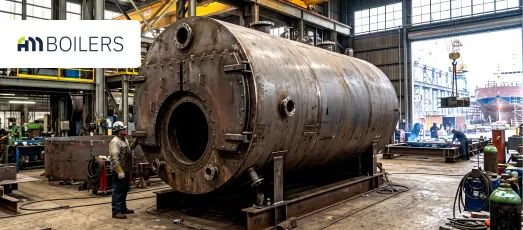
Custom boiler fabrication involves designing and manufacturing a boiler or its major components according to the specific requirements of a vessel or marine application.
Unlike an off-the-shelf unit, a custom system can be developed around factors such as available installation space, steam capacity, working pressure, fuel type, piping arrangement, connection points, weight restrictions, and the vessel's existing machinery.
The scope can range from individual pressure components and boiler tube fabrication to major repair or replacement work. Depending on the project, fabrication may include pressure parts, tubes, headers, furnace components, supports, mountings, and other associated components.
The objective is to achieve a safe and practical fit without compromising the boiler's intended operating performance.
Boilers provide steam for several essential shipboard operations. Depending on vessel type and design, steam may be used for fuel oil heating, cargo heating, tank cleaning, machinery heating, domestic services, and other auxiliary requirements.
This makes boiler reliability particularly important. A fabrication defect, incorrect material, poor weld, or dimensional mismatch can create problems after installation and may lead to leakage, premature deterioration, or difficulty during marine boiler maintenance. Regular inspection and proper maintenance help identify such issues early and support reliable boiler operation.
Marine boiler fabrication therefore has to account for the operating environment as well as the physical design. The equipment must withstand pressure, temperature, vibration, thermal cycling, and the conditions associated with marine operation.
Marine applications use different boiler arrangements depending on the vessel, steam demand, fuel system, and machinery configuration.
Auxiliary boilers generate steam for services such as fuel heating, cargo operations, tank cleaning, and other onboard requirements. They are commonly designed around the vessel's specific steam demand and available installation space.
These systems recover heat from engine exhaust gases to generate steam or improve overall energy utilization. Their design has to account for exhaust temperature, gas flow, heat-transfer requirements, and the characteristics of the connected engine.
Composite boilers combine different heat sources, typically allowing steam generation through both fired and exhaust-gas heating arrangements. Their fabrication requires careful integration of the heating surfaces and associated systems.
The exact boiler configuration should always be selected according to the vessel's operational requirements rather than simply choosing a standard capacity.
A successful fabrication project begins well before cutting or welding starts.
The first stage is understanding what the vessel actually needs. Engineers review steam capacity, operating pressure and temperature, fuel arrangement, installation dimensions, connection points, available space, and intended operating conditions.
The information is translated into drawings, dimensions, material specifications, pressure-part requirements, and fabrication details. Existing vessel drawings and measurements are particularly important for retrofit projects.
Materials are selected according to pressure, temperature, corrosion exposure, welding requirements, and applicable specifications. Material traceability is important for pressure-containing components.
Plates, tubes, headers, and other components are prepared and assembled according to approved fabrication drawings. Welding procedures and qualified personnel are essential for pressure-part construction.
Fabricated components undergo dimensional checks, weld inspection, non-destructive testing where required, and pressure or other specified tests before acceptance.
For a vessel project, fabrication does not end when the component leaves the workshop. Installation compatibility, transportation, onboard fit-up, connection requirements, and commissioning support also need to be considered.
The design has to balance performance with the practical realities of a vessel.
Steam capacity and pressure determine the basic boiler sizing and pressure-part design.
Available space is particularly important during retrofit work. The fabricated unit must fit through available access routes and into the designated machinery-space location.
Weight and support arrangements also matter because additional structural loading may need to be considered.
Fuel and combustion requirements influence burner selection, furnace dimensions, air supply, and control arrangements.
Maintenance access should not be overlooked. Components that require regular inspection or replacement need sufficient access for engineers to work safely.
Connection compatibility is another practical consideration. Steam, feedwater, fuel, exhaust, drain, electrical, and control connections must correspond with the vessel's existing systems or the planned modification.
The material of the parts will vary depending on boiler design and the service for which it is used. The selection criteria for pressure-containing parts will require selection of a material which possesses the appropriate mechanical properties at its intended operation temperature and pressure.
General-use carbons and low alloy steels are commonly employed in boiler construction; however, special use may indicate selecting the required material based upon temperature considerations or corrosions consideration, or unique fabricating needs.
Selection should never be solely based upon the fact that the material is available at the fabrication site. Whether material designation, grade, thickness, material certification, welding characteristics, etc., conform to the proper design requirement should always be checked.
Traceability of material from receipt through fabrication is a key aspect of quality control for pressure equipment.
A well-executed custom boiler fabrication project can provide several practical benefits.
Better Vessel Compatibility: The boiler or component can be designed around the actual dimensions and connection requirements of the vessel.
Easier Retrofit Integration: Custom fabrication can be particularly useful where an existing boiler needs modification or replacement but the original configuration is no longer readily available.
Improved Maintenance Access: Designing around the vessel's operating environment allows maintenance access and component replacement requirements to be considered from the beginning.
Reduced Installation Complications: Accurate dimensions and connection planning can minimise unnecessary modification during onboard installation.
Longer-Term Reliability: Correct material selection, fabrication practices, welding quality, and testing reduce the risk of premature defects.
Custom fabrication can be required across different vessel types and situations, including:
This is especially useful where there is minimal access to the machinery space, where the boiler is old, where superseded equipment and marine spare parts are being used, or where the machinery installation is not standard compared with commonly available replacement parts.
As pressure equipment, marine boilers will fall under the rules governing a particular vessel, flag, class society, and project.
IACS formulates unified requirements that cover various aspects of machinery installations, pipes and pressure vessels, materials and welding, and survey and certification, and that form part of the minimum technical standards under the IACS structure; in addition, the rules and regulations and additional requirements required by the individual class society may be applicable.
In accordance with projects and jurisdiction, it may be necessary that other boiler and pressure-equipment codes, in which ASME is included, be considered. ASME provides Boiler and Pressure Vessel Codes containing rules relating to materials, fabrication, examination, testing, and quality control, where section I deals with power boilers only.
It may be sufficient for the marine project not to rely simply on one set of the mentioned standards. It should be required for a fabricator to identify which rules apply specifically to a vessel project before fabrication.
Quality has to be controlled throughout fabrication rather than checked only at the end.
Typical quality activities can include:
Testing specifications depend on design as well as the governing rules. Marine rules, for example, would demand hydrostatic testing for all boilers and pressure vessels before service installation.
“In pressure equipment, precision is not a finishing touch. It is part of the design itself.”
A strong quality process therefore links engineering, material selection, fabrication, inspection, testing, and documentation into one controlled workflow.
The lowest of the quotes will necessarily be the lowest on the project. Marine boiler fabrication requires special skills, for if an error is only found after delivery/installation onboard, the remedial work will cost a fortune.
Before selecting a fabricator, consider:
A fabricator who also performs repairs and inspections can give the client further advantage in that actual conditions under which the boiler will be operating will be taken into consideration to arrive at fabrication parameters.
While fabrication may not prevent every operating issue, it can help prevent defects caused by poor workmanship and design errors. Good fabrication and marine boiler repairs can reduce the risk of premature leakage when tubes are properly welded and positioned. Selecting the correct material ensures pressure components suit the design operating conditions, while dimensional accuracy limits installation problems. Adequate inspection can also catch fabrication errors before operation, helping identify when a boiler needs immediate servicing in UAE.
Poor fabrication, on the other hand, could result in defects relating to welding, tube leakage, dimensional errors, corrosion at an early date, issues fitting components together, and repeat repairs.
That is the reason why marine boiler fabrication solutions should be judged not on the speed it can deliver production, but on how they are engineered and the quality level provided.
AM Boilers offers combined expertise in boiler engineering, fabrication, repair, and inspection, along with their marine backup. This experience is a definite advantage where fabrication requirements are related to a prior boiler failure, retrofit, reinstallation, or a maintenance-related activity.
Inspection, marine boiler maintenance and repair, along with fabrication and tube works, refractory and insulation requirements, are looked at in tandem with marine technical backup; this helps keep actual field service and installation practical conditions of the boiler while considering fabrication.
This system can ease the overall process for owners and operators of vessels, for whom fabrication for boilers is merely one section of a requirement. It's considered as a part of an overall unit for construction that is intended for fitting, testing, maintaining, and performing within operational limits rather than simply as a piece for workshops.

Custom marine boiler fabrication is far from producing an item that fits some particular measurements. It’s knowledge of the vessel, steam requirements, the working conditions on the ship, installation restrictions, required future maintenance, etc., and relevant technical regulations.
Whether it be selecting materials, boiler tube fabrication, welding, testing, and so on. At each stage, something could be at risk.
Whether this is a retrofit, replacement boiler, re-tubing, or new-build application, selecting a fabricator with experience will be the difference between supplying what might just about “do” compared to what has been engineered for the job.

