2026-10-27
The use of the boiler on a ship is diverse and may include such operations as heating fuel oil, running cargo pumps, and supplying steam to the accommodation. In case there is any breakdown in the boiler when the ship is at sea, the maintenance can be carried out only when the needed spare is available.
For this reason, marine boiler spare parts are considered an essential part of the maintenance plan of every vessel. Even a small item, for example, a gauge glass or an ignition electrode, can bring the boiler to a stop when no spare is kept. In this blog, we will discuss the spare parts that ship operators should keep in stock, the time of their replacement, and storing them in the correct manner.
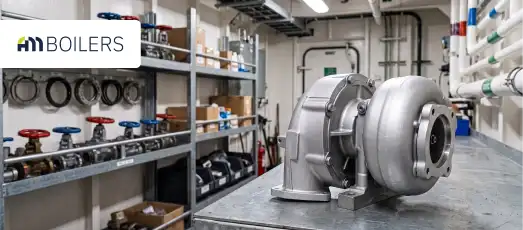
The marine boiler spare parts refers to those replacement components that are required for keeping the main, auxiliary, or exhaust gas boiler of a ship in a safe and working condition. This list comprises smaller consumable spare parts, including seals, gland packing, and spark plugs, and larger spares that include safety valve units, pipes, and parts of the feed pump.
In most cases, classification of spare parts is mainly done based on their use systems. The main systems are the combustion system, the water level and control system, the pressure parts, and the safety devices. A few of these parts are changed during every routine overhaul, while others are stored on board only for use at the time of a breakdown.
Ship operators usually keep a combination of OEM parts, which are supplied by the boiler manufacturer, and equivalent parts, which are manufactured as per the same specification. Whichever option is chosen, the part should fit properly and should fulfil the requirements of the boiler manufacturer as well as the classification society of the vessel.
A detailed explanation of the main categories is in our article on what are marine spare parts.
When a ship is on a sea passage, the nearest port or supplier may be at a distance of several days. In case a burner component or a level switch fails and no replacement is available on board, the boiler may have to remain out of service till the ship arrives at the next port. On longer routes, this situation can continue for many days.
By maintaining a planned stock of boiler spare parts, ship operators get the following advantages:
However, the stock on board also needs the support of a reliable supply chain. If operators purchase their marine boiler spare parts from an experienced supplier, restocking can be done faster, and the operators can be more confident that the parts will suit the boiler.
The list of spare parts will not be the same for every ship, because it depends upon the type of boiler, its age, and the recommendations given by the manufacturer. Still, the parts mentioned below are kept on board on most vessels.
Burner nozzles, atomizer tips, ignition electrodes, ignition transformers, and flame scanners are included in this group. These parts get worn out in normal operation, and if a nozzle gets blocked or a flame scanner stops working, the boiler will not be able to fire.
This group consists of gauge glasses along with their gaskets, level electrodes, float switches, and pressure switches. A gauge glass may crack without much warning, and it is not safe to operate the boiler without a clear indication of the water level.
Springs, discs, seats, and parts of the easing gear are required for keeping the safety valves in working condition. Since these valves have the main role in marine ship boiler overpressure protection, damaged parts should be replaced only with correct and certified spares, and the valve should then be reset in the presence of a surveyor.
Tube plugs, spare tube lengths and sealing materials are stored so that the crew can isolate a leaking tube. With the help of these spares, the boiler can be kept in service until a permanent repair is done.
Manhole gaskets, handhole gaskets, flange gaskets and gland packing for valves are needed whenever the boiler is opened. Because these items are low in cost and are used quite often, a sufficient quantity should always be available on board.
A small stock of castable refractory, insulation, and fixing materials helps the crew in repairing minor damage near the burner or on the walls of the furnace before the damage becomes larger.
Mechanical seals of feed pumps, parts of fuel pumps, solenoid valves, and filters are necessary for maintaining the supply of water and fuel to the boiler. A failure of the feed pump seal can stop the boiler as quickly as a fault in the burner.
All of these items together make up the basic marine boiler maintenance parts which are required on most ships. Nevertheless, the list should also be checked against the manual of the manufacturer and the maintenance records of the vessel, as every boiler has its own weak areas.
Some parts are replaced at fixed intervals, as decided by the boiler manufacturer or the planned maintenance system of the ship. Other parts are replaced when an inspection or a drop in performance shows that they have become worn. Some common parts and the signs which show that replacement is needed are given in the table below.
| Part | Signs It Needs Replacing |
|---|---|
| Burner nozzle | Poor flame shape, smoke, carbon build-up |
| Ignition electrode | Delayed or failed ignition |
| Flame scanner | Frequent flame failure trips |
| Gauge glass | Cracks, cloudiness, leaks at the gaskets |
| Safety valve spring or seat | Simmering, leaking, lifting at the wrong pressure |
| Manhole and handhole gaskets | Every time the joint is opened |
| Boiler tube | Thinning, leaks, bulging found during inspection |
| Feed pump seal | Leakage at the pump shaft |
| Refractory | Cracks, spalling, exposed steel |
Those parts which are connected with safety, such as components of the safety valve, gauge glasses and flame scanners, should be replaced without delay once a fault has been noticed. If the boiler is operated with a defective safety device till the next port call, the crew as well as the vessel may be exposed to risk.
The significance of a spare part can be determined only when it is easily available and in perfect condition whenever needed. If the spare parts are not stored properly, there can be a problem of rusting of the spare parts, and on occasion, it may be found that their size does not fit. The following practices can help to overcome such situations.
A list should be prepared of all those parts without which the boiler cannot be operated, along with their part numbers, quantities, and minimum stock levels. This list should be reviewed after every survey and after any major repair.
All spare parts need to be kept in a place that is dry and clean, and each part needs to have an appropriate label. The gaskets will need to be kept horizontally, while the refractories need to be kept dry and need to be used before the expiry of their shelf life. Precise parts such as nozzles will need to be kept in the package until they are used.
All parts that have been removed from the store should be logged into the maintenance system. Once the stock is at its minimum, the order needs to be placed before the arrival of the ship at the port to give the supplier enough time to deliver the parts.
The boiler model, the part number, and the material specifications need to be checked before placing an order. The points that need to be checked, including certification and reliability of the supplier, are explained in our guide on key factors to check before buying marine spare parts.
Ship operators should also be careful while selecting marine spares suppliers. A good supplier will have proper knowledge of boiler systems, will provide the necessary documents along with every part, and will be able to make deliveries at the ports where the fleet calls most frequently.
Al Mufaddal Boiler has been involved in the work of marine and industrial boilers since 2004. As a marine boiler spare parts supplier that also has its own repair and fabrication teams, we understand the function of each part inside the boiler, and not merely its listing in a catalogue.
We provide OEM as well as compatible spare parts for boilers, heat recovery steam generators, and associated thermal systems. The parts match their original specifications in order to fit in the system and work exactly how the boiler manufacturer designed them to be.
Our engineers assist clients in identifying the correct part, in checking its compatibility, and in deciding which spares should be kept on board. This reduces the possibility of ordering a part that does not fit.
Apart from the supply of marine spare parts, we also carry out boiler inspections, overhauls and voyage repairs through our riding crews. Because of this, ship operators can depend on a single team for the parts as well as for the work of installing them.

If the right spare parts for marine boilers are available onboard, any small fault will not become a large problem for the boiler at sea. The operators must concentrate on the parts for burners, gauge glasses, safety valves, gaskets, and feed system spares. They must maintain the spares properly and order new ones before they run out. With the right supplier, the boiler will operate safely between ports.

