2026-10-19
When you ask a marine engineer about the noise a safety valve makes when it blows open, you will have an instant answer – it is noisy. Sometimes there is no warning at all. But most likely something has occurred in the firing or in the steam demand. But the noise does not indicate any trouble. It indicates that the valve functions well. The valve automatically rises as soon as the pressure exceeds the set point and, therefore, the steam is discharged without causing any harm to the drum or tubes.
The safety valve is a small device close to a boiler. However, the significance of the valve in this situation is great. This guide tells you about how the valve works, types of valves, components of the valve you may face on board a vessel, symptoms of valve failure, and valve maintenance.
It's a valve held shut by a spring, and it's mounted on the boiler drum. Many boilers carry one on the superheater too. The valve opens once steam pressure hits a set level. There's no switch, no power supply, and no signal involved. The pressure of the steam is what moves it.
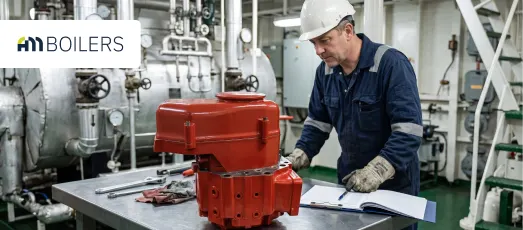
After enough steam has gone, pressure falls by the required amount. The spring then pushes the valve back down onto its seat, and the boiler goes on running. The crew still has one question to answer: why did the pressure climb?
Two valves per boiler is the usual setup. Classification rules commonly ask for at least two once a boiler is above a certain size. That way, a second valve is ready if the first one gives trouble.
The exact spots depend on the boiler design. You'll find them on the drum and on the superheater. The superheater valve has a second use. As pressure builds, it keeps steam moving through the superheater.
The right valve is only half of it. You also need the right spares. With a dependable source of marine boiler spare parts, a worn valve part doesn't leave you waiting long.
A boiler failure on land is bad. A failure at sea is worse. The engine room is a closed space, the crew is small, and help may be far away. A pressure problem doesn't get much time to grow before it turns dangerous.
The causes can be very ordinary. A burner control might not cut back at the right time. A turbine or cargo pump might trip. Steam demand then drops fast, but the boiler is still making steam. Or a stop valve gets shut at the wrong moment.
A working ship boiler safety valve doesn't wait for anyone to reach the control panel. Pressure gets to the set point, and the valve opens. Steam goes out.
This stops the pressure from rising to a level that could damage the boiler's pressure parts. It also explains why surveyors check safety valves closely during every boiler survey.
Yes, the lifting valve will indeed release pressure. It will also send a message to the engineers. Something is wrong with either the firing process or the steam generation process, and it has to be investigated.
When the valve opens unexpectedly, the engineers will have to investigate the reason for the increased pressure. The valve will be protecting the boiler at that point in time.
The concept is straightforward. Steam forces the disc upwards while the spring forces it downwards. The spring will be more powerful as long as the steam pressure remains below the set pressure, thereby keeping the valve closed.
Once the steam pressure exceeds the set pressure, the force under the disc will overpower that of the spring.
The steps run in this order:
The quick opening is by design. A valve that opened just a little would chatter on its seat. It would wear out faster, and it still wouldn't release enough steam.
The main job is to keep the drum, tubes, and headers away from pressure higher than they were designed for.
Class rules generally say the valves must be large enough to hold pressure to no more than about 10% above the approved working pressure. That has to be true even with the burner at full output, and the main steam stop valve closed. Surveyors prove it with an accumulation test.
In case the pressure is higher than the allowable limit, then the valve lets steam out. This helps to reduce the strain on the pressure-containing elements.
In its absence, the strain keeps increasing on the drum, the tubes, the headers, and the welds.
Superheater valves are usually set slightly below the drum valves. So the superheater valve lifts first, and steam keeps moving through the superheater tubes.
If that flow stops, the tubes can get far too hot. The chance of damage rises quickly.
A lifting valve is a clear signal to the engineering crew. Pressure has reached the set point, and the firing or steam system needs a check.
The easing gear adds another option. The crew can lift the valve by hand from a safe place, for example during an emergency or a fire.
So a safety valve does more than let steam out. It keeps the pressure parts of the boiler within safe limits.
Designs aren't all the same. Age, pressure, boiler design, and maker all play a part. Still, the basic parts are much the same in most marine boiler safety valves.
If you know the parts, wear is easier to spot. Ordering spares gets easier too.
The usual parts are:
These components are part of the wider range of marine machinery spares, including different types of marine spare parts.
Marine boiler safety valves come in four main types: ordinary spring-loaded, improved high-lift, full-lift, and full-bore pilot-operated. They differ mainly in how far the disc lifts and how much steam they can release.
This is the simplest design. The disc lifts only a short way, so the valve must be fairly large to pass enough steam. They are mostly seen on older boilers and low-pressure auxiliary boilers.
A floating ring or waste piston helps push the disc higher. The extra lift lets a valve of the same size release more steam.
These open so far that the seat bore sets the flow, not the lift. They are common on modern marine boilers. A compact valve can dump a lot of steam very fast.
A small pilot valve operates a much bigger main valve. They fit high-pressure systems that need a very large discharge capacity.
A safety valve can fail in two ways, and both are trouble. A valve that will not open puts the whole boiler at risk. A valve that will not close wastes steam and fuel. Here is what each one looks like on board.
The situation when the valve remains closed is the most severe problem. As there will be no mechanism for controlling the pressure, the weakest part will break first. It can be a tube, a weldment, or the boiler itself.
In an engine room, the consequence will be scalding steam, damage, fire, and the vessel becoming powerless.
Another problem is when the valve does not close completely or leaks after its seat. This problem is more gradual and not so dramatic, but it still leads to negative consequences.
Steam will continue leaking out, and fuel consumption will increase. Also, the steam leakage will cause corrosion of the seat. In addition, if the drain in the exhaust steam pipe is clogged, the condensate will accumulate in the pipe.
The most common causes are:
A safety valve can go for years without lifting, and that's the real problem. A valve that hasn't moved for a long time is the one most likely to stick when it's needed. Testing and inspection matter for this reason.
Valves are normally set under steam with a class surveyor present. This usually happens after an overhaul, as part of the boiler survey. The surveyor checks the lifting pressure and blowdown, and then seals the setting.
An accumulation test may also be done. In between surveys, the crew should move the easing gear now and then to confirm it's still free.
Each valve is opened up at survey time. The seat and disc are checked for cutting, pitting, and other damage. The spindle is checked for bends or corrosion, and the spring for cracks or lost tension.
The waste steam pipe, its supports, and its drain need a look too.
Minor scratches on the seat can easily be ground away. If the springs, spindles, or discs are damaged or worn, use replacement certified components.
Keep the drain pipes open. Record each lift and setting on the log. Do not change the position of a sealed valve unless you are conducting the survey.
A matching flange doesn't make a valve the right one. A replacement boiler safety valve can look correct and bolt on fine, yet not protect the boiler as it should.
Before you order, check these points:
For more details on supplier reliability and quality checks, see key factors to check before buying marine spare parts when selecting a replacement marine boiler safety valve.
Al Mufaddal Boilers has been working on marine and industrial boilers since 2004. We supply and service marine boiler safety valves. We also do boiler repair, inspection, and spare parts. Ship superintendents get one team for several boiler needs.
Our engineers have worked on auxiliary boilers, economizers, and exhaust gas boilers. For that reason, we treat a boiler safety valve as one part of the whole steam system. Fitting the flange is only the start.
We supply OEM and equivalent spares for boilers and related thermal systems, including safety valve components. Each part is matched to the original specification, so it works as it should.
We inspect valves during boiler surveys, carry out overhauls, and support setting and testing. Our riding crews can also take on repairs while the ship is underway. Once the vessel reaches port, there's less delay.

Although the marine boiler safety valve is a relatively small component of the boiler, it is very important for the safety of the boiler and crew. If pressure goes above the allowable level, the valve allows excess steam to escape from the boiler and prevents damage to pressure parts of the boiler.
The selection of the proper valve is only half the battle. The other half is regular testing of the valve, inspecting it properly, having good drains, and proper easing gear. As soon as a valve or any of its parts shows wear, it should be repaired or replaced with certified parts.
A safety valve does not have to act daily, but when it is necessary, it must be perfect.

