2026-08-20
The dilemma of whether marine boiler repair should be performed or the boiler should be replaced is often not a question of accepting one quote or another. Factors like the condition of the pressure parts, the age of the boiler, the cause, severity, and frequency of the last repairs, boiler operation history, and any future scope in class requirements or in operations, as well as the future of the vessel, must be taken into consideration. In many instances, a specialized repair is still enough for the boiler to continue running reliably.
On the other hand, in some specific conditions, the frequency and scope of repairs no longer become technically and economically feasible.
To find the proper solution, a professional condition survey, rather than a catastrophic failure, must initiate the whole procedure.
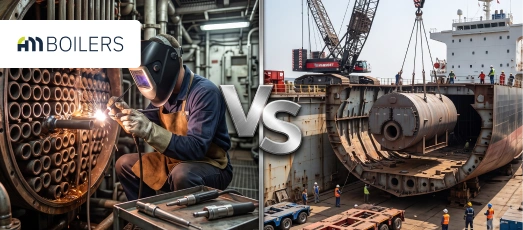
It is one type of pressure vessel, used for the purpose of steam production for different marine services, for fuel and cargo heating, for cleaning of the tanks, for heating the machinery, for domestic services, and for many other on-board services. Its performance depends on many mutually connected parts like tubes, headers, burners, furnaces, refractory, feedwater systems, valves, safety accessories, instruments, and controls. Any damage at any single point affects the working of the whole system.
Hence, it is very important to decide on marine boiler repair and replacement by not referring to the working of one component but the overall parts associated with it. The failed tube might be repairable; however, a frequently occurring tube failure can signify a more comprehensive failure related to corrosion, water chemistry, overheating, or the age of pressure parts.
A boiler does not always fail suddenly. Changes in its operating behavior often provide the first indication that something is deteriorating.
Common warning signs include:
One isolated issue does not automatically mean the boiler needs emergency boiler replacement. The important question is whether the problem is local and repairable or part of a wider decline in boiler condition.
Marine boiler repair is undertaken to repair faulty, worn, or damaged parts, ensuring your boiler is able to function safely and reliably again. Depending on the current state of your marine boiler, boiler repair services may involve plugging or replacing tubes, tube replacement (retubing your marine boiler), marine boiler pressure part repairs, boiler burner repairs, marine boiler refractory repairs, boiler valve repairs, welding marine boilers, boiler cleaning, replacing insulation, and boiler control system repairs.
The boiler repairs in UAE and voyage assistance provided by AM Boilers consists of inspection of the boiler, hydro-testing, tube plugging, full or partial retubing of the boiler, repair of the furnace, and updating of insulation and refractory.
Repair should always tackle the problem, not the failed component (e.g., if a tube failed due to corrosion and it is replaced without looking at water chemistry or a possible corrosion source, it may leave it untreated).
When pressure parts are concerned, the actual repair method employed is of significance, and while it is known that boiler tube plugging can influence circulation of water, heat transfer & thermal load, DNV states that it needs to be assessed, and class and manufacturer requirements need to be followed when performing the repair.
Annual boiler maintenance generally makes sense when the boiler remains structurally sound and the damage is limited to specific components.
It can be a practical option when:
The damage is localised
A limited number of damaged tubes, valves, refractory sections, or burner components can often be repaired without replacing the complete boiler.
The pressure parts remain in good condition
If inspection shows acceptable wall thickness and no widespread cracking or corrosion, repairing affected areas may provide many more years of service.
The boiler has a manageable repair history
An occasional repair is different from a boiler that requires repeated major intervention. If failures are isolated and the rest of the system remains healthy, repair can be the more sensible route.
The repair can restore performance
A successful repair should return the boiler to a safe and functional condition rather than simply keeping it operational for a short period.
Replacement would cause unnecessary disruption
For vessels with demanding schedules, a well-planned repair may avoid the longer downtime associated with complete replacement, provided the boiler remains technically suitable.
Boiler replacement means removing the existing boiler and installing a new unit or an appropriately engineered replacement system.
Replacement, unlike repair of a component, is the treatment of the boiler itself as a total asset and is typically called for when, in existing, no further maintenance is considered economic and sufficiently reliable, efficient, or operative.
Emergency boiler replacement often entails far more than simply the installation of the new boiler: depending on the design of the vessel, it can entail changes to foundations, associated pipework, the fuel system, electrical supplies and connections, controls, exhaust systems, insulation, etc.
Due to the above factors, replacement requires considerable pre-engineering before its introduction.
There is no universal age at which every marine boiler should be replaced. Condition and operating history matter more than age alone.
Replacement becomes more compelling when several of the following are present:
A boiler that is 20 years old but well maintained and structurally sound may be a better candidate for repair than a younger boiler suffering from extensive deterioration.
| Factor | Marine Boiler Repair | Boiler Replacement |
|---|---|---|
| Initial cost | Usually lower | Generally higher |
| Downtime | Often shorter | Usually longer |
| Scope | Specific components or systems | Complete boiler system |
| Best suited for | Localised damage | Widespread deterioration |
| Service life | Can extend existing life | Provides a new service period |
| Planning | Usually simpler | Requires detailed engineering |
| Long-term value | Strong when boiler condition is good | Strong when repeated repairs are no longer practical |
The table is a useful starting point, but the final decision should come from a technical condition assessment.
Cost is important, but it should not be the only consideration.
Examine tube thickness, corrosion, cracking, headers, furnace condition, and other pressure parts. AM Boilers can carry out visual examination, ultrasonic thickness gauging, dye penetrant and magnetic particle testing, radiography, and other tests to meet your inspection requirements.
Look to the future, not to the last breakdown! Has your boiler required more frequent repairs each year: tube work or burner callouts? Then it’s time to think bigger and consider what really needs to be changed in the long run and whether the last call is an indicator that a decision has to be made.
Don't look past that last failure. If this boiler has needed more frequent tube repair work, or more burner service, or emergency calls, the trend might be an indication of a bigger choice looming.
For example, a repair that can be carried out during a normal port stay will be preferable to an emergency boiler replacement project that involves considerable downtime. On the other hand, if considerable work is to be carried out anyway during drydocking, it may make more sense to replace it.
Older boilers can be challenging to keep functional when an original component is discontinued, or the expertise to maintain it is unavailable. This leads to added repair time and increased long-term operation risk.
Age is only part of the equation, not the sole determinant. Properly maintained pressure-part systems can continue working for decades, while boiler fires and combustion systems can sometimes be refurbished with reasonable repairs. Regular industrial boiler maintenance can also help extend equipment life and identify potential issues before they become major problems.
But if a boiler with age already suffers chronic malfunctions that, on their own, begin to dominate maintenance dollars, then the boiler has aged out a different way.
Instead, it’s preferable to look at the condition report rather than the condition report and age. These documents reveal whether the damage is confined to replace part’s that just cost money because you just can’t find those that will last, or if the body of the boiler has become too fragile for much longer work.
Where the balance of choice falls in favor of the equipment's life in years, the first decision to make will always focus on whether it is safe to repair or replace. Technical repairs: Although it might be technically feasible to make a repair that brings the equipment back into operational condition, it may not be the right repair to make if it doesn't take into account the relevant classification, flag, manufacturer, or statutory requirements. It's one of our most recent notes of caution that we have brought to class that, in a boiler, such as tube-plugged items, will require class consideration and approval for some repairs.
However, the environmental implications are likely to play a part in the decision process too. If you have an old boiler that is running inefficiently, for example, poor combustion or reduced heat transfer, it will likely be guzzling fuel much more voraciously than its more up-to-date rival. If the vessel still has many years of operating life, then a greater operating efficiency might favor a new build.
The best way to delay an unnecessary boiler replacement is to understand the condition of the boiler before serious deterioration develops.
By routine examination, such as this survey team did at the West Memphis site, signs of tube wastage (corrosion), deposit formation on tubes, refractories eroding, and boiler damage can be picked out and monitored before serious consequences develop. Other preventive measures like boiler-feedwater control, maintenance of burners, boiler cleaning, checking and tightening of operating safety devices (e.g., level controllers), and preventive maintenance and repair have an even greater impact. DNV says that greater emphasis on the maintenance of the boiler and corrosion control is the solution to significantly reduce needless on-service boiler damages.
Even so, this won't make an old boiler new.
At least it looks at the condition, and planning for emergency repair and replacement can be done in an ordered fashion.
AM Boilers operates within Al Mufaddal Engineering & Marine Services. It has been dedicated to the cause of marine & industrial boiler systems for over two decades, and its services encompass inspection, repair, maintenance, fabrication, emergency responses, supply of spare parts, and riding crew services. Operators who are torn between replacing and repairing a boiler would benefit from having this extended capacity readily available.
This is mainly because the decision to repair and replace does not end as a suggestion to the customer.
The boiler can be checked for its condition, the root of the deterioration identified, and repaired or re-tubed if it is feasible to do so, and additionally support a larger scope of repairs when necessary.
For urgent situations, AM Boilers also provides emergency boiler repair support across UAE ports. Its published services include emergency repair, tube work, burner rectification, refractory repair, cleaning, and spare-parts supply.
This means the focus remains on finding the most appropriate solution for the boiler's actual condition, not automatically recommending repair or replacement.

Choosing between marine boiler repair and boiler replacement should never be based on age or repair cost alone. We need to know how the parts are currently performing. We need to review a recent failure in a local part in the boiler itself; we need to check the efficiency and security level and which spares are ready to take on the job, on top of planning what happens with our vessel time. In the case we verify the equipment is OK, but the fault is a specific part on a boiler, effective repairs may extend its full working life.
If not, comprehensive wear and tear would justify its substitution for a newer one, saving cost and time to be more safe for ourselves in future use.
The only way to ensure a good investment in proceeding with the repairs is to know the condition and current state well, enabling vessel owners to do the correct intervention, avoiding and keeping away from the boiler from the emergency boiler repair and replacement process.

