2026-10-08
Talk to a few plant engineers, and you'll hear the same worry come up: the boiler fault nobody saw coming. From the outside, a unit can look perfectly normal while one of its tubes is losing wall thickness every month, or a safety valve has been stuck on its seat since the last shutdown. An industrial boiler inspection helps you catch that during a shutdown you scheduled, not in the middle of a production run.
Here, we'll cover what inspectors look at, how the work runs on site, which defects they find most often, and how often you should book one. The examples come from jobs our own crews have worked on.
The term industrial boiler inspection is defined as the inspection of the boiler by a qualified inspector. Pressure parts, burner, safety devices, and controls: all of it gets looked at. On a ship, they'll also check it against class society rules. On land, it's usually ASME and whatever your insurer requires.
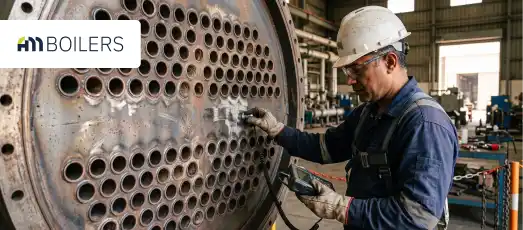
Don't expect a quick walk around. For an internal inspection, the manhole doors come off, and someone gets into the drum with a torch and a thickness gauge. The logbook gets read, page by page. At the end, you get a written report, and that report tells you what can wait and what can't.
The two types include:
When a drum or a header fails, it's serious. All that steam and stored energy has to go somewhere, and quite often it goes towards people and the equipment around the boiler.
Safety is the first reason to keep up a regular boiler safety inspection. It isn't the only one:
Here, the climate makes things harder. Summer heat, humid air, and feedwater that tends to be hard or a little salty all push scale and corrosion along faster than owners usually expect, especially at coastal plants. The more experienced boiler inspection services in UAE spend extra time on the water side for this reason. With a planned industrial boiler inspection, you'll usually find this damage while it's still a cleaning job and not a retube.
In brief, anything that is under pressure, anything that uses fuel, and anything that is used in order to prevent accidents from happening. The majority of the time is spent on those components that may unexpectedly fail, such as tubing, welds, and safety devices. The remaining portion of the inspection covers the burner, insulation, and paperwork. The following is what each component entails.
Shell, drums, headers, and the furnace are checked for bulges, cracks, pitting, and corrosion. The welds and openings always take longer to examine, as this is where stress can accumulate.
Anyone who has ever performed a retube knows that this is where problems can start. An ultrasonic gauge measures the thickness of the tube. Erosion and blistering are examined in bends and soot blower lanes.
Every safety valve, low water cutoff, pressure switch, and flame safeguard is tested at its set points. If the safety valve doesn’t lift off, the boiler remains out of service until the problem is solved. Not negotiable.
A flue gas analyser enables the inspector to determine pretty quickly whether the burner configuration is correct. Poor combustion of fuel leads to wastage. Soot also accumulates on the tubes because of poor combustion, leading to ineffective heat transfer.
If refractory or insulation is cracked or missing, the steel behind it is sitting right in the flame. Outside cladding gets checked too. Gaps let heat escape and can give an operator a nasty burn.
Analysis of feedwater, blowdown data, and the old log book will provide the reason behind the defect before any testing apparatus can be used.
An effective inspection entails all the components that come under pressure, fuel burning, and protection. When all of it is done in one inspection session, the report comes up with a clear repair schedule.
This list will help you prepare for an inspection. It applies to most fire tube and water tube boilers; however, if your OEM or local inspector calls for more, then defer to their guidance.
What operators do between visits matters just as much. From what we've seen, sites that keep on top of boiler inspection and maintenance get shorter reports and fewer surprises. Our industrial boiler maintenance checklist lists the daily, monthly, and yearly jobs.
From one site to the next, the order of work hardly changes. Knowing it in advance makes it much easier to plan the shutdown and the people you'll need.
The drawings, report, and log precede the inspection. These help inform the inspector about the risks involved even before they step into the boiler room. Historical records of any maintenance work carried out, inspections performed, and operational records show the problem areas.
With this information, one will be able to set priorities and select the tools for the inspection process. Just a few hours of preparation will save a whole day on site.
The boiler is turned off and cooled down gradually since it may crack when it cools down too fast. When it is drained and shut off, it is opened up so that people can enter it. The fuel lines are also closed off. This step needs time, but it makes everything safer for those who have to work inside the boiler.
Inspection here refers to inspecting the two faces of the boiler: the water side and the fire side of the boiler. Abnormal features such as deposits and distortion are detected and tested. Other factors that get inspected include corrosion, leakage, and tube damage, among others. Sometimes walking around the boiler is enough to get an idea of possible problems before any equipment is employed.
Here is where ultrasonic testing, dye penetrant testing, magnetic particle testing, radiographic inspection, and infrared thermography come in. This reveals what our eyes cannot detect without causing destruction of any part. Every test detects various types of faults, such as wall thinning, hairline cracks, or even poor welds.
As needed, we do hydrostatic testing to see if the boiler is capable of holding its pressure. We then move on to testing the valves and controls under actual operating conditions. Safety valves, gauges, and control systems are checked to confirm they respond as they should. This is the final proof that the boiler is ready to run safely again.
Photographs, documentation, and an equipment repair list will be given to you. The report is quite simple and tells you which repairs are immediate and which are required during the next shutdown. The report also assists you in budget planning and scheduling of future work. Having everything documented in front of you, the next inspection becomes quite easy to prepare for.
A boiler does not normally fail without any prior warning signs. Most often, the defect has been there for months, but it is small enough to go unnoticed, and that is where the inspection comes in.
| Problem | What It Usually Points To |
|---|---|
| Scale buildup | Weak water treatment, overheating risk |
| Internal corrosion and pitting | Dissolved oxygen or off-target pH |
| Tube thinning | Erosion, corrosion, or plain age |
| Cracks near welds | Thermal stress or fatigue |
| Bulging or blistering | Local overheating |
| Faulty safety valves | Sticking, wrong set point, wear |
| Damaged refractory | Frequent cycling or flame impingement |
| Leaking gaskets and joints | Wear or careless reassembly |
Even the smaller boilers have the same troubles. The commercial boiler inspection carried out in hotels, hospitals, or laundries will find many of the same issues, only in a smaller boiler. Other indicators may appear while running the boiler regularly: hammering sounds in the piping, fluctuations in the pressure, or water marks on the boiler. If any of this sounds familiar, check out the symptoms that provide signs your boiler needs immediate servicing.
It is, of course, plant-specific. However, what happens in most cases is something along the following lines:
For ships, it is the class that determines the survey frequency. For plants on land, it is the local authority and their insurer. If your boiler is old, uses poor-quality water, and runs round the clock, have it inspected more often. In the case of a less-used plant, you can use the commercial boiler inspection with a simpler schedule.
How often you inspect also shapes your boiler inspection cost over the years, though not in the way most people think. Skipping a year seems cheaper, right up until an emergency retube and a week of lost production show up on the same invoice. We think of inspection as the start of a longer working relationship, and from inspection to lifetime boiler support explains how that works.
Al Mufaddal Boiler has been inspecting and repairing marine and industrial boilers since 2004. We're a trusted boiler services company in UAE with our own repair and fabrication teams, so the people who find a defect can also fix it.
Our engineers have worked inside boilers, economizers, HRSGs, and auxiliary systems, on ships and in plants. After enough of those jobs, you can tell normal ageing apart from an early warning. That experience helps us spot small signs that a newer eye might miss.
This way, we also know how a worn part appears prior to becoming a failure. It means that you can rely on the recommendations given by people who have encountered the issue many times before.
Our industrial boiler inspection services include visual assessment, ultrasonic thickness gauging, dye penetrant, magnetic particle testing, radiography, and infrared thermography, all handled by our own people. Since we do not hand this work to another firm, there is no waiting on outside teams or schedules. Each method is chosen for the fault it finds best. The result is a clear and complete picture of your boiler’s condition.
We work to ASME, API, and the major class society standards. Our audit reports are formatted according to the requirements of auditors and certification organizations. Thus, you will not need to do extra work such as rewriting and formatting the documents before the audit takes place.
Tube manipulation, refractory, fabrication, and riding crews are all in-house. Fewer handovers mean shorter downtime and a boiler inspection cost that's easier to predict. If you're comparing boiler inspection services in UAE, you get one team responsible for the whole job, start to finish.

In the final analysis, it all comes down to whether the boiler is in a condition to be operated safely. The inspection report on the boiler shell, along with the maintenance done between inspections, helps answer that question. When a boiler is maintained regularly between inspections, small problems have little chance of turning into big ones. So the schedule must be followed, and the recommendations in the report should be taken seriously and acted on in full.

