2026-05-29
In this guide, we discuss the signs of an ailing boiler, the common implications, and the right course of action in relation to them. This pertains to the servicing of industrial as well as marine boilers in the UAE.
There are unique factors involved during a boiler operating in the UAE. In coastal and marine environments, the boilers can be corroded by salt, and in hot climates where sustained temperatures are high, this combined with a constantly high load and hard water high in mineral content, will reduce wear and corrosion.
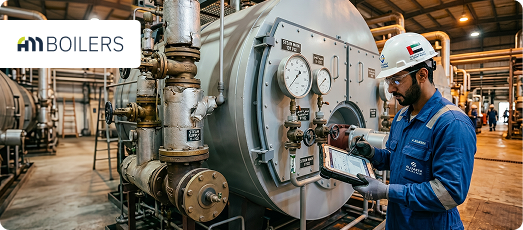
Timely boiler servicing UAE isn't just about preventing a breakdown. It is about ensuring that the unit is operating at peak combustion efficiency, that its safety features are working, and that its classification society requirements and local UAE regulations are being met.
A boiler not serviced on time doesn't just operate poorly; it becomes increasingly inefficient and unsafe until the moment when it can be replaced.
Learn More: What Is Annual Boiler Service and Why It’s Important?
Sounds like banging, rumbling, or hissing are boiler warning signs and cannot be overlooked. Banging is a sign of kettling (scale built up on tube walls creating hot spots), whereas rumbling may indicate combustion issues. Hissing from the body or fittings is likely to be an indication of a water or steam leak.
Any signs of water gathering at the bottom of the boiler, stains appearing on the casing, or water dripping from fittings and joints signal the fact that the unit is leaking. Leaks could come from cracked tube joints, failing gaskets, poorly made fittings at the gauge, cracks at headers, etc.
One of the earliest indications of boiler failure is an inability to generate or sustain operational pressure, or if the amount of steam being produced fluctuates without any changes to the load. Examples include the fouling of tubes, the malfunction of the burner, and the failure of the control systems.
This indicates the boiler is using much more fuel to achieve the same output of steam; it is therefore less efficient than before. Tube scaling is the main culprit here; a small amount of scale on the tube surface provides the barrier that needs to be overcome to heat the steam. The burner then has to fire longer to reach the required temperature.
When a boiler repeatedly trips out, even though it is reset, it is not functioning correctly. The initial shutdown may be for a simple reason, but repeated trips in a short space of time strongly indicate an unrectified fault, such as a fault sensor, control fault, combustion problem, or water fault causing a high TDS cut out.
A drop in the operating pressure out of the normal range is an indication of steam leakage, underworking of the feed pump, a failing pressure control valve, or tube leakage. A low pressure affects all subsequent stages and is potentially an undesirable working condition.
Fuel oil smell, deposits of burnt fuel, or flue gas where it would not be expected to be indicate there is a problem with combustion or with flue gases. Smoke in the boiler room signifies there is an escape of flue gas that may represent a risk to life and limb, or indeed a fire.
A well-burning flame should be blue, with an even and symmetric shape. If the flame is too yellow/orange and bright, then combustion is not complete. Incompletion of combustion can be due to no air supply, a damaged or clogged atomiser, impure fuel, or a dirty burner head.
Alarms are provided to indicate conditions that are outside of the normal operating limits. A single alarm that stops without being reset, and then does not return, may be a transient condition. Recurring alarms are indicative of problems with the boiler.
Boilers above 15 to 20 years, especially marine boilers, which are likely to have large cumulative running hours, do show a decline in performance, which isn't due to a single fault but the accumulation of various smaller issues.
There are some dominant root causes for the vast majority of boiler failures within the marine and industrial environments:
In industrial applications: process plants, desalination, power generation, and petrochemical sites, boilers begin to run less efficiently. Look for: increasing stack temperatures, an increasing fuel/steam ratio, increasing blowdown rate required to control TDS, and periodic pressure control problems.
Industrial boiler maintenance in the UAE is important to take into account the water quality. The place has a large amount of hard water, and boilers tend to run at higher temperatures here.
A salty atmosphere promotes external corrosion of the casings, fittings, and casing insulation jacketing. Movement of the vessel impacts the water level and gauge reading controls.
Typical marine boiler warning signs are the following: fuel viscosity readings that are abnormally high and that have an impact on combustion, salt contamination of the feed water by condensers, and unusually rapid corrosion on casings and cladding about deck penetrations and around vents.
Learn More: What Does a Boiler Service Include? Industrial & Marine Boiler Guide
Daily checks to be carried out by engineers on site, a full inspection by a specialist each quarter, and a complete annual service following the requirements of regulation or classification rules.
Given the working conditions of continuous high loads, high ambient temperature, and marine corrosion, it makes sense to reduce the required inspection frequencies from those typically seen in milder environments.
All newly installed boilers should undergo a service inspection within 3 to 6 months of being commissioned. All boilers that give any indication, as outlined in the warning signs, should be inspected before their next required service interval.
Learn More: How Often Should A Boiler Be Serviced in UAE? (Complete Maintenance Guide)
In case of failure of a boiler on a UAE port, the general procedure adopted by a professional boiler emergency service team is as follows: immediate mobilization at the berth, inspection on board and root cause determination, assess damages, temporary fixing if a proper solution is time-consuming or unavailable locally, execute permanent repair as per class approval.
Typically, the difference between dealing with an emergency effectively and suffering a prolonged failure is the availability of a properly trained team on-site.
Learn More: What to Do During a Marine Boiler Emergency Near Dubai, UAE Port
Immediately call an engineer if:
Regarding scheduled servicing, arrange the necessary service call with a professional boiler service company in the UAE well before your certificate expires.
Al Mufaddal Boilers is a trusted boiler service company based in Dubai for more than 20 years and has completed over 3000 contracts for clients in the marine, Oil and Gas, Petrochemical, and desalination industries. Their team of 110+ engineers and technicians provides the complete service for boilers from inspection work through to retubing, burner overhaul, refractory repairs, high-pressure jetting, and supplying spares.
The company also provides 24/7 emergency support to major UAE ports: Jebel Ali, Port Rashid, Hamriyah, Khalifa Port, and Fujairah, with equipment and parts to repair rather than just diagnose issues.
AM Boilers also operates scheduled industrial boiler repair and maintenance services and offers documented reports and programmed service schemes to comply with the rules of the classification societies.

A boiler will signal if it is experiencing a problem. Noises (other than the usual hum), a sudden dip in pressure, abnormal flame colors, greater fuel consumption, frequent alarms - all of these things do not occur simply to cause a minor inconvenience. They are early indications that a developing fault is progressing towards a more severe outcome.
Dealing with boiler issues as soon as they appear is always much cheaper, faster, and safer than addressing a full-blown boiler failure. If your boiler shows any of the signs that you can find in this guide, you must get it inspected. The perfect time to ask for professional assistance is before a total boiler failure occurs.

