Menu
2026-11-19
On most ships, the economizer receives attention only when a problem occurs. It's there in the funnel or exhaust line, taking the heat out of the hot gases and reusing it.
If it becomes plugged, corroded or leaking the ship will burn more fuel and the boiler will have to work harder. In the extreme case, you can actually get a soot fire. Most of the problems with marine boiler economizers start off very small and if the crew know what to look out for they will be able to spot the symptoms fairly easily.
This blog is a brief explanation of how an economizer works, the various causes of the problems that can arise, the signs to look out for and how you can keep it in good order.
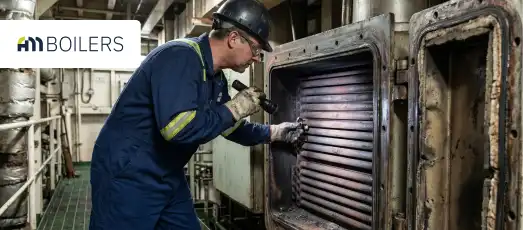
A marine boiler economizer is a heat exchanger which takes the waste heat from the hot gas and uses it to heat the water. On many ships, it will be in the exhaust uptake of the main engine (in which case it's an exhaust gas economizer) and can in fact produce steam whilst the ship is at sea with no extra fuel being consumed at all. It can also be after the boiler and in that case it will be used to pre-heat the feedwater prior to it going into the boiler.
Either way, the principle is the same. Hot gas flows over a bank of tubes and water flows in the tubes. The water takes up the heat that would otherwise just go out the funnel. A lot of economizers use finned or pinned tubes as the extra surface area enables them to pick up a massive amount of heat in a very small space.
This heat recovery makes the economizer an important part of the boiler system. A properly working economizer can provide the bulk of a ship's steam requirements at sea and that in itself will lead to a reduction in fuel consumption. This reduces the need to operate the oil-fired boiler.
The vast majority of marine economizer problems are down to what's happening either side of the tubes: the dirty hot gas on the outside and the water on the inside. Those are the two main causes.
Exhaust gas from heavy fuel oil is full of soot and unburnt fuel, which will of course deposit on the tubes (particularly the finned tubes) and build up over time. That's what's known as economizer fouling and it gets progressively worse the longer the engine is running at low load.
Fuel which contains sulfur will give rise to gases which will condense to form sulphuric acid as they cool. If the tube surface temperature falls below the acid dew point, the acid will form on the metal and attack it. This is one of the main causes of economizer tube corrosion and it is the cold end of the economizer which is most affected.
Inside the tubes, you get problems due to poor water treatment. Dissolved oxygen leads to pitting and hard water leads to scaling. The scale forms a blanket on the inside of the tube and so less heat gets through. The metal then ends up a lot hotter than it should.
If enough soot and grease accumulate in the tubes, they may ignite even when the engine is operating. The probability of occurrence increases when water circulation stops or performs poorly while the engine runs. A serious soot fire may cause melting of tubes and critical damage to the whole economizer.
Soot blowers fitted incorrectly will, of course, wear the tubes down over the long term. Vibration in conjunction with the heating and cooling cycle will also crack the welds and the tube supports.
These problems can vary depending on the economizer design, operating conditions and maintenance practices used in industrial and marine boiler systems.
In most cases, an economizer shows warning signs before a serious problem develops. The table below shows what to watch out for and what each of those indications generally signifies.
| Warning Sign | What It Usually Points To |
|---|---|
| Gas-side pressure drop slowly rising | Soot and economizer fouling blocking the gas flow |
| Higher exhaust gas temperature after the economizer | Less heat being picked up, often due to fouling or scale |
| Lower steam output from the economizer | Fouling, scale, or poor water circulation |
| Water dripping from the uptake drains or soot hoppers | Economizer tube leakage |
| Boiler water level or feedwater use going up for no clear reason | A leaking tube inside the economizer |
| White vapor or wet soot at the funnel | Water escaping from a leaking tube |
| Sudden rise in gas or casing temperature | A possible soot fire |
| Sparks from the funnel | Burning soot, often an early soot fire |
| Rust-coloured or acidic drain water | Low-temperature corrosion on the gas side |
If you see any of these, then it's definitely worth checking straight away. A small leak or a light layer of soot is a lot easier to sort than a burst tube or a fire.
If an economizer becomes inefficient, the repercussions are significant and can affect several parts of the vessel. Here are the most important effects:
Put it simply, a neglected economizer is costing you money every day right up until it fails. Delaying repairs can make boiler economizer problems more expensive to fix. than they would have if you'd simply dealt with them at an early stage.
Economizers are inspected either during a dry-dock, during a planned shutdown or when the crew suspects there's a problem. A proper inspection would normally involve the following:
For a full condition check by experienced engineers, the marine boiler inspection service checks the rest of the boiler.
The overwhelming majority of marine boiler economizer problems can be sorted out through good daily practice. These steps are simple, but they must be followed regularly.
Run the soot blowers as often as the manufacturer recommends and more frequently when the engine has been running at low load. They must be correctly aimed and timed to ensure the tubes are cleaned without damage.
If soot blowing is insufficient, then water washing can be used to remove the hard deposits. Only do this when the engine is stopped and of course the economizer must be completely dry afterward to prevent any corrosion.
Do not stop the circulation pump while hot exhaust gas is flowing through the economizer. Dry and overheated tubes are one of the main causes of soot fires and tube failures.
Keep the water entering the economizer warm enough so that the tube metal stays above the acid dew point. That's one of the best ways of avoiding economizer tube corrosion at the cold end.
Test and treat the boiler water regularly to control the oxygen, the pH, and the hardness. Water in the tubes that is clean means less scale and less pitting.
Good economizer maintenance is all down to how well the unit was built in the first place. The components will last a lot longer if they've been properly bent, welded and tested, making boiler fabrication for efficient systems just as important as regular day-to-day maintenance.
Not every problem shall require a new economizer. Some could be resolved with a simple clean or a minor boiler economizer repair. This is just a general guide
| Situation | Usual Fix |
|---|---|
| Light soot or deposit build-up | Soot blowing or water washing |
| Scale inside the tubes | Chemical cleaning and better water treatment |
| One or a few leaking tubes | Plugging the tubes as a short-term fix, then repair |
| Tube walls thinning in one area | Replacing the affected tubes or sections |
| Widespread corrosion or many plugged tubes | Replacing the tube panel or bundle |
| Serious soot fire damage | Full inspection, usually followed by panel replacement |
Tube plugging can provide a temporary solution while the vessel is at sea, but of course every plugged tube takes away some of the heating surface. If you get to the point where too many tubes are plugged, the economizer simply won’t function properly, and it’s far better to replace the panel. Planned economizer tube panel fabrication during a dry dock is normally a lot cheaper than having a failure at sea
Use this as a simple checklist. Always follow the manufacturer's manual and your ship's planned maintenance system.
Daily
Weekly
Monthly
At dry dock or planned shutdown
Regular economizer maintenance like this works best as part of wider marine boiler repair and maintenance, so the boiler and economizer are looked after together.
Al Mufaddal Boiler has worked on marine and industrial boilers for over two decades. Our marine boiler economizer services cover inspection, cleaning, boiler economizer repair, and full replacement, so ship operators can use one team for the whole job.
Our engineers will be looking at the tubes, the panels and the heating elements and will produce a full written report with clear next steps. The report clearly explains which repairs are needed and which can be scheduled for later.
We remove the scale, sludge, rust and mineral deposits via a controlled chemical clean and flush and then check the results to ensure performance is back to where it should be.
We can renew the water tubes, tube panels and heating elements and can supply fins, pins and bare tubes with class certificates. We can also make coils to the original maker's design.
Economizer failures don't just occur at a convenient time. We have 24-hour support and our riding crews can do the work whilst we're at sea.

The vast majority of marine boiler economizer problems are soot, corrosion or poor water care related and pretty much all of them will give you an early warning. Watch the temperatures and the pressure drop, do regular soot blowing, keep the water circulating and treat the water. If you do regular inspection and get the right bits sorted in time, then the economizer will be saving you fuel rather than costing you.

