Menu
2026-11-13
A boiler can have a fantastic burner, perfectly clean water and the right fuel and still be a total waste of heat. The problem can lie right in the parts themselves. The tubes, the panels and the pressure parts are all made in a workshop prior to the boiler even starting to run.
The way they are fabricated in that workshop has a huge impact on the heat transfer through the parts. That's industrial boiler fabrication. A tube that's been bent too much or a weld that hasn't been done correctly will stop the heat transfer and will result in that part wearing out prematurely.
This blog looks at how the fabrication is carried out, what the standards are, which defects are the most expensive and what you should be looking for in a fabricator in Dubai and the UAE.
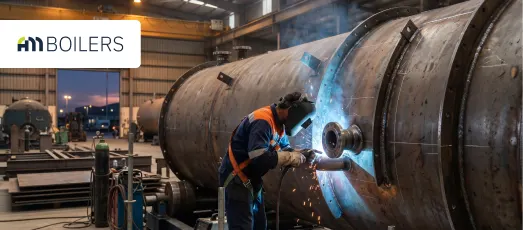
The process of industrial boiler fabrication is the process of making the boiler components that are the ones designed to hold pressure and/or to transmit heat. These are the tubes, headers, drums, economizers, superheaters, the heating elements and all the associated pipework.
The bulk of the work is carried out in the workshop under ideal conditions for the work in question. A bit of it is done on site. Some of it is "first time" work and some of it is work to make up pieces to replace existing modules in the boiler. The parts in question operate at high pressure and temperature, so the fabrication of the boiler pressure parts is highly controlled. Every weld, every material and every test is recorded so that the part can be traced back to its source should a question ever arise.
A boiler works in a very simple way, in fact. The heat from the hot gas goes through the tube wall and heats the water on the water side, which then becomes steam. If anything slows that heat down, the boiler will have to burn more fuel to produce the same quantity of steam. A lot of these problems either turn up or are sorted out in the workshop during fabrication.
Here’s how the quality of the build shows up in everyday running:
Cost is another big reason to care about it. A well-built part will last longer between repairs, which in turn means fewer shutdowns. For a plant or ship that is running on steam 24/7, that level of reliability is just as important as the fuel savings. That's why owners are looking for boiler fabrication services in Dubai where accuracy and testing are part of the job rather than something you tack on at the end.
The boiler fabrication process is very linear. You go through each stage in turn and there are checks at each stage. A part won't move on until the prior stage has been cleared.
The process begins with engineering drawings and design calculations. The design temperature, design pressure, tube size, and the material grade are verified according to the applicable code. If it is a replacement component, you will have to measure the current boiler in place so that the new item fits without problems.
All the tubes, plates and fittings are checked against the factory certificates. The material grade, size and heat number are all noted down for each item so that the inventory can be traced in the future.
Tubes are cut to length and then bent to the required radius. Good bending will, of course, maintain the wall thickness and roundness within specification. Any layout which isn't a standard pattern (coils and serpentines, for instance) will require some degree of custom tube manipulation to get the shape right.
Qualified welders will weld the tubes, headers, and fittings using the relevant WPS and PQR. TIG welding is commonly preferred for the tube root runs as it gives a very clean, well-controlled bead. MIG and stick (SMAW) are used on the heavier sections.
Some materials and wall thicknesses will require post-weld heat treatment in order to relieve the stresses introduced by the welding and to reduce the risk of cracking in service.
The welds are NDT'd and the complete assembly is pressure tested. Dimensions are checked against the drawing prior to approval.
Larger systems are normally built as modules in the workshop and then installed on site. The modular pre-fabrication of the boiler reduces the amount of site work and makes the shutdowns far easier to plan, as such a large proportion of the welding and testing has already been done prior to the boiler being taken offline.
Pressure parts are never built on the fabricator's judgment. They are built to published codes which specify the rules for design, materials, welding and testing. The code that applies is a function of where the boiler is to be used and who is going to certify it. Good boiler pressure part fabrication starts with establishing the applicable code prior to any material being ordered.
| Standard or Body | What It Covers |
|---|---|
| ASME Boiler and Pressure Vessel Code | Design, materials, welding and testing of boilers and pressure vessel fabrication |
| ASME Section IX | Qualification of welding procedures and welders |
| API standards | Fired heaters, piping and equipment in oil and gas plants |
| Classification societies (LR, ABS, DNV, BV, RINA) | Approval of materials, welders and work on marine boilers |
| Third-party inspection (TPI) | Independent witnessing of tests and checks during fabrication |
For marine boiler fabrication, the class society will have to approve the welders and will have to witness the key tests. Onshore plants work with the insurers, the local authority and a third-party inspector.
Compliance continues after delivery. Regular boiler inspection services confirm that the fabricated components remain within safe limits for their service life.
Selecting the best material for the right spot and employing the appropriate technique ensures that a boiler remains operational efficiently over time.
Carbon steel tubes are used for the majority of the water wall and economizer work. Chrome-moly alloy steels are used in the hotter areas (e.g., the superheaters) as they maintain their strength at high temperatures.
Stainless steel is the material of choice for heating coils and any components that are going to be in contact with corrosive fluids or condensate. It's more expensive initially but will generally prove to be much more durable in those circumstances.
Fins increase the surface area on the gas side so more heat can be recovered from the same area. That's why they're so prevalent in economizers and waste heat recovery boilers. The reliability of the economizer tube panel fabrication is all down to good fin bonding and even tube spacing.
In orbital welding, the welding torch rotates around the tube to give every joint the same quality. This is great when working with various identical joints on panels and coils.
Controlled bending guarantees the preservation of the round shape of the tube and even wall thickness during the process. The bend doesn’t affect the water flow in the tube or its strength.
The vast majority of fabrication defects are not visible once the part has been installed. They manifest themselves later as leaks, hot spots or a slow decline in efficiency. The table below lists the more common ones.
| Defect | Effect on the Boiler | How to Prevent It |
|---|---|---|
| Porosity in welds | Weak joints and leaks under pressure | Clean surfaces, correct shielding gas, qualified welders |
| Lack of fusion | Hidden weak spots that can crack | Approved procedures and NDT on critical joints |
| Tube ovality at bends | Restricted flow, thinning, early failure | Correct bending tools and bend radius |
| Misalignment | Stress on joints, leaks, uneven heating | Accurate fit-up and dimensional checks |
| Excess weld penetration | Disturbed flow and deposit build-up | Controlled root runs, often by TIG |
| Wrong material grade | Overheating or corrosion in service | Verification against material certificates |
| Residual stress | Cracking after start-up | Post-weld heat treatment where required |
Finding these problems in the workshop is a lot cheaper than fixing them after a shutdown. Coils are a perfect example. In the fabrication of a heating coil, one defective joint can disrupt an entire land-based tank heating system on land or the cargo heating on a ship to a complete standstill, so every weld has to be of the same standard.
There are a multitude of workshops in the area that can do welding. Only a handful, however, can actually build pressure parts to code and get a boiler running reliably for years. So before you go ahead and order any industrial boiler fabrication, make sure you check those points.
Working with a boiler repair and fabrication company in Dubai is also advisable. The company focuses on both boiler repair jobs and boiler fabrication jobs in terms of making new boilers, as it ensures awareness of the weak traits of various spare parts of boilers. You require a company that also has industrial fabrication services covering pressure vessels, piping, skids, and other boiler equipment.
Al Mufaddal Boilers have been in the ship and factory boiler business for over 20 years. We manufacture high-quality boiler components such as tube panels, coils, pressure vessels, pipes and ready modules. As a boiler repair and fabrication company in Dubai, we build everything to last.
Certified Welders and Workshops
We are LR, ABS, DNV-GL, RINA and BV certified. We have over 110 TPI-certified engineers and welders on our team.
Workshops in the UAE and Bahrain
We have workshops in Dubai, Fujairah, Umm Al Quwain and Bahrain. We maintain a stock of certified boiler tubes, finned tubes and steel plates, which enables us to get started immediately.
Testing and Heat Treatment Under One Roof
Non-destructive testing (NDT) is used to test the welds without having to cut any of the metal. We do our post-weld heat treatment in-house. This is to relieve the stress that is left in the metal as a result of the welding. Our pressure vessel operations are ASME-compliant, and all work is backed up by full written quality assurance.
Marine and Onshore Support, 24/7
We have teams on site in plants and ships right across the UAE and the entire GCC region. Sailing crews can carry out boiler work whilst on voyage. Our teams are on site 24/7.

The quality of the industrial boiler fabrication has a direct bearing on the efficiency of heat transfer, the life of the boiler components and the frequency of repair. The key to good quality is good bending, good welding, proper testing and the use of traceable materials. Good workshop performance translates into fuel savings, fewer outages and a longer life for the boiler systems.
Yes. Al Mufaddal fabricates economizer tube panels in panel, circular wound, pancake and serpentine configurations as well as heating coils for boilers, economizers, and process heaters. For more information on our economizer tube panel for heating coil fabrication work (including on-site refurbishment), please see the relevant section.

