Menu
2026-11-24
A marine economizer plays an important role in recovering heat from engine exhaust. It recovers heat from engine exhaust that would otherwise escape through the funnel and uses it to make steam whilst at sea.
It only works well when the outside of the tubes is clean and the inside is in good condition. As time goes on, soot, corrosion and poor water care all have a detrimental effect on marine economizer performance and often you don’t realize it’s going down until the fuel bill starts to climb. Regular maintenance and professional marine economizer services can help prevent or reduce this loss in performance.
In this blog, we look at how an economizer works, seven ways you can improve it, what numbers to be looking at and when it’s time to repair or replace.
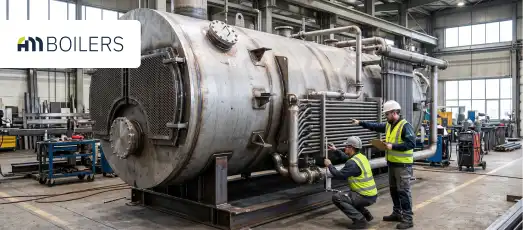
A marine economizer is a heat exchanger in the exhaust path of the main engine or boiler. Hot exhaust gas flows over a bank of tubes with water in them. The water takes up the heat which would otherwise be lost and that heat is then used to generate steam whilst the ship is at sea.
That’s what marine economizer heat recovery is. The ship uses the engine’s waste heat for fuel heating, accommodation and so on, so it doesn’t have to run the oil-fired boiler. When the economizer is working, the boiler can effectively be on standby for the majority of the voyage.
A lot of economizers feature either finned or pinned tubes, thereby providing greater heat transfer surface for the gas. For a closer look at the different designs, read our complete guide to boiler economizers.
Clean heat-transfer surfaces and proper water circulation are essential for good economizer performance. The following seven methods can help improve performance.
Soot is the main cause of heat loss in the economizer. The soot blowers should be run in accordance with the manufacturer’s recommendations and more frequently when the engine is at low load, as that’s when the soot build-up is most rapid.
Soot blowing may not remove all hard or sticky deposits. They can be removed with a water wash when the engine is shut down, but the economizer has to be properly dried afterwards to prevent corrosion.
The circulation pump must operate whenever hot exhaust gas is passing through the economizer, as required by the manufacturer’s instructions. If the flow is low or uneven, then some of the tubes will overheat, resulting in reduced heat uptake and an increased propensity for soot fires and economizer tube failure.
If the water going into the economizer is too cold, then the tube surface can drop below the acid dew point and corrosion will commence. The feedwater inlet temperature should meet the minimum limit specified by the manufacturer in order to protect the cold end.
Scale on the inside of the tubes acts as insulation and oxygen leads to pitting. The water side is kept clean via regular testing and dosing to control oxygen, pH and hardness.
Slow steaming will save fuel; it just results in a cooler and sootier exhaust. Wherever possible, short periods at higher load are used in conjunction with a good deal of extra soot blowing to clear the deposits.
By measuring the pressure drop in the gas side as well as the temperatures on both sides of the economizer, you’d find out you’re facing issues a lot earlier than you’d reach a failure point. Detecting minor changes at an early stage is much simpler and cheaper.
Put together, these steps are the most reliable way to improve economizer efficiency on a vessel without spending money on new equipment.
Even a well-designed economizer will suffer some degradation of performance as it ages and the rate at which that occurs is very much a function of the fuel, the operation and the maintenance.
One of the main causes of reduced performance is economizer fouling. The soot and unburnt fuel in the exhaust build up on the tubes and fins and eventually form a layer which completely stops the heat transfer. It also restricts the gas passages, so the engine has to work against a higher back pressure.
Other causes build up quietly in the background:
The majority of the changes occur gradually, which is why they’re so easy to miss. It’s the regular checks carried out by marine boiler inspection services that will pick up the deterioration before it starts to show up in the fuel bill.
A few key readings can help assess economizer performance. The table below shows what to measure and what the various figures generally indicate.
| Indicator | What to Watch For | What a Change Usually Means |
|---|---|---|
| Gas-side pressure drop | A slow, steady rise | Soot and deposits building up |
| Exhaust gas temperature after the economizer | Rising over time at the same engine load | Less heat being picked up |
| Temperature drop across the economizer | Getting smaller | Fouling or scale cutting heat transfer |
| Steam output from the economizer | Falling at the same engine load | Fouling, scale, or circulation problems |
| Feedwater inlet temperatur | Dropping below the maker’s limit | Higher risk of cold-end corrosion |
| Circulation flow rate | Lower than normal | Pump or valve problems, risk of overheating |
| Boiler water use | Rising for no clear reason | A possible tube leak |
| Number of plugged tubes | Growing with each survey | Less heating surface and an aging tube bank |
Always compare readings at a similar engine load. A higher exhaust temperature at full power is absolutely normal so the only trends that really matter are the ones you get at the same loading.
Regular checks and maintenance play an important role in maintaining economizer performance. Use this checklist in conjunction with the manufacturer’s manual and the ship’s planned maintenance system.
Every watch or daily
Weekly
Monthly
At dry dock or a planned shutdown
Fuel oil contains sulfur. On burning, some of that sulfur will form gases which will condense to form sulphuric acid if they cool sufficiently. The temperature at which this condensation occurs is the acid dew point. This will be in the region of 110-160°C (depending on the sulfur content of the fuel) and will be lower for the lower-sulfur fuels.
The problem is when the tube surface temperature is below that of the acid. The acid will then condense directly onto the metal and attack it. This is most likely to happen at the cold end of the economizer where the feedwater enters and the gas is at its coldest. It will, of course, thin the tubes and lead to leaks.
In order to secure the cold end:
A soot fire occurs when the soot and oil build-up on the tubes actually catches alight. A small one may just go out on its own but a large one can get to a very high temperature. In the extreme case, the steel tubes themselves can ignite and the economizer can be destroyed.
Be on the lookout for any sudden increase in the temperature of gas in the economizer, an increase in the temperature of the casing, signs of fire (sparks in the funnel) or an unusual smell of burning. The fire alarms situated in the uptake (if present) are the most obvious.
Keep the tubes clean with regular soot blowing. Don’t run the engine for long periods at low load without some extra cleaning and by no means stop the water circulation whilst the engine is running. Good combustion in the engine will result in less unburnt fuel in the exhaust.
Follow the manufacturer’s emergency procedure (reduce engine load or shut the engine down, keep the circulation pump running and don’t use the soot blowers as air or steam can feed the fire). For a larger fire, you’d use a large quantity of water via the washing or firefighting system. Small quantities of water can in fact make a very hot fire considerably worse.
After any soot fire, the economizer should be fully inspected prior to it going back into service. Regular inspection and maintenance can also help prevent other common marine boiler economizer problems.
Not every problem requires a new economizer. A cleaning or a minor repair may be all that is needed. This table is a general guide.
| Condition | Best Option |
|---|---|
| Soot or deposit build-up | Soot blowing or water washing |
| Scale inside the tubes | Chemical cleaning and better water treatment |
| One or a few leaking tubes | Plugging at sea, then repair at the next port |
| Thinning in one area of the tube bank | Replacing the affected tubes or sections |
| Many plugged tubes or widespread corrosion | Replacing the tube panel or bundle |
| Heavy soot fire damage | Full inspection, usually followed by replacement |
| Design that fouls quickly or recovers too little heat | Retrofit with a better tube layout or fin design |
Tube plugging can provide temporary relief, but each plugged tube reduces the available heat-transfer surface. Once too many tubes are plugged, the economizer can’t do its job properly. At that point, planned economizer tube panel replacement during dry dock usually costs much less than an economizer tube failure at sea.
Al Mufaddal Boilers has worked on marine and industrial boilers for over two decades. Our marine economizer services cover inspection, cleaning, repair, and replacement for every kind of marine boiler economizer so that ship operators can work with one team from start to finish.
Our team will evaluate every part of the unit and will create an overall detailed report. The report will clearly identify the repairs required.
We remove the scale, sludge, rust and mineral deposits via a controlled chemical clean and flush and then check the results to ensure the economizer is performing to specification.
We renew water tubes, tube panels and heating elements and can supply fin, pin and bare tubes with class certificates. Coils can be built to the original maker’s design as well.
Our team offers round-the-clock emergency support, and our riding crews can carry out repairs while the vessel is at sea.

Good marine economizer performance is all about regular cleaning, good water circulation and the right operating conditions. Keep a close eye on your key figures, respond to the small changes as they occur and plan your maintenance accordingly so that you're not left with an emergency. A properly looked-after marine boiler economizer will save you fuel and boiler hours for a long time.

