2026-04-25
Here, it is just not about the technical expertise; it is about clarity, speed, and accurate decision-making under stress. Marine engineers and technical personnel are often forced to make decisions based on very little information and time. Without a structured approach, even a minor fault can be amplified into a major problem unnecessarily.
So, this is a hands-on guide that focuses on real-world scenarios and boiler troubleshooting steps that will help you effectively respond to a marine boiler emergency.
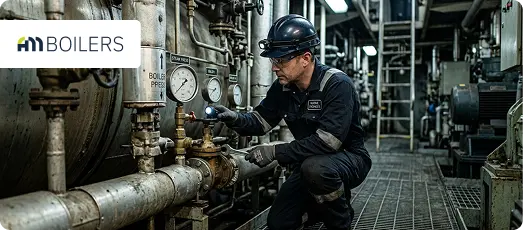
Boiler repair emergency refers to a rapid or unintended failure of a ship's boiler system that prevents it from operating safely and generating steam. These could include boiler tube failure, over-pressure conditions, burner faults, loss of water level, or refractory failure. This situation requires an emergency shutdown and professional troubleshooting.
It all begins with the marine boilers. Without them, it's not possible to supply steam to heat the fuel oil, to the accommodation and cargo spaces, and to run the deck machinery. If a boiler fails, nothing downstream will work.
Onboard operations that depend on a continuous supply of steam are directly impacted by boiler failure. The viscosity control on fuel systems is lost, and all cargo operations become unstable.
The auxiliary systems go out of operational optimum limits, and within moments, a single point of failure can affect different systems, which makes recovery that much more complicated. High-dependency vessels like tankers, bulk carriers, and offshore support vessels could completely shut down without prompt action.
The safety hazards posed by the loss of control of a boiler are much more severe than just the financial implications. These include loss of steam pressure from the vessel, risk of fire from fuel oil systems losing heat, and environmental violations. With the amount of time delay, all of these possibilities become more probable.
An understanding of the type of failure enables the correct personnel and equipment to be mobilised with immediate effect.
The common causes are scale deposits, corrosion fatigue, and poor water treatment. If a tube failure occurs, there is a rapid pressure drop, and it can damage the shell and cause immediate steam loss. This is a very common repair problem encountered at UAE ports by specialist repair crews.
A drop in pressure indicates either a leak, a lack of feedwater supply, or failure of the control valve. A buildup in pressure signifies that the boiler has exceeded its intended safe operating parameters and is in danger of blowing out its shell or repeated safety valve lifting.
These are commonly caused by contaminated fuel, blocked atomisers, and igniter wear. It is possible to reset after one lockout. Repeated lockouts occurring within a short interval are a signal of a combustion fault that requires manual inspection and replacement.
Low water causes the tubes to be subjected to dry heat, which can result in the boiler or its tubes melting down or exploding. High water causes carry-over, which means the boiler water gets converted to steam and gets injected, causing steam contamination. Both conditions can disable the boiler and cause further damage.
Economisers recover heat from the exhaust gas for higher efficiency. Tube leaks, significant fouling, and/or casing cracks result in decreased efficiency and an excess of the exhaust gas temperature. If left unattended, the economiser’s damage can propagate to the main boiler.
In the case of cracked or spalled refractory, the boiler furnace shell is subjected to temperatures of combustion that it was never intended to withstand, resulting in hotspots, distortion, and a loss of thermal efficiency.
The following procedure must be followed precisely. In an emergency, the sequence is just as important as what actions you take.
1. Start the emergency shutdown procedure. Either trigger the manual trip or verify automatic shutdown is already in operation. Verify the boiler has been disconnected from all associated equipment.
2. Isolate fuel and steam supply. Close fuel oil supply valves at the burner and at all downstream steam isolations. Ensure both remote and primary valves are closed.
3. It is vital not to let pressure build up and safely vent using a safety valve or blowdown. Do not attempt to force-cool a hot boiler - this thermal shock will put stress on the boiler and can add to the tubes/shell damage.
4. Activate the relevant onboard safety systems. Respond to all alarms. Check that fire detection systems are active in the boiler room. Ensure ventilation is on and prevent further access until the space is safe.
5. Inform the Port Authority and technical support. Inform your technical superintendent, and schedule boiler repair emergency near Dubai, UAE, if shore support is required.
6. Make a full log of all the data prior to any resets. It is necessary to record all the alarm timestamps, pressures, temperatures, and control system fault codes. All of this data is needed to help in fault-finding and must be recorded for class surveyors.
After all urgent safety procedures have been carried out, you should systematically check that all details are passed onto the repair team, so they turn up to the job with correct spares and tools:
Visual Inspection
Alarm Diagnosis
Steam & Pressure Indicators
Burner System Checks
Feedwater System
There are specific fault conditions that are simply too hazardous for the ship's engineers to safely carry out themselves. Immediately call the emergency boiler support team in these cases:
Vessels operating at the UAE terminals may obtain a complete spectrum of specialist services in case of emergency. A competent team must be able to provide the following on short notice:
Al Mufaddal Boilers, based in Dubai, operates with a 110+ team of certified marine engineers and technicians, delivering 24/7 emergency marine boiler repair, inspection, troubleshooting, and maintenance services for vessels calling at major UAE ports including Jebel Ali Port, Port Rashid, Hamriyah Port, Khalifa Port, and Port of Fujairah.
Our rapid-response teams support shipowners, fleet managers, and marine operators with boiler breakdown assistance, burner repairs, retubing, refractory works, safety valve servicing, and onboard emergency maintenance, minimizing vessel downtime and ensuring compliance with international maritime safety standards.
Having an insight into this process allows the vessel operator to be well coordinated and have realistic expectations since the first call is received.
The boiler faults are most likely to appear when the vessel system is being used the most - typically during approach to or departure from port.
Most marine boiler casualties are preventable. They are the outcome of deferred maintenance, inappropriate water treatment, and missed inspections. Consistent application of these tips intends to minimise unintended failures.
In the case of vessels on time-charter arrangements, there is a direct cost associated with each hour that boilers are unavailable. Beyond 48 hours of charter delay, a penalty exposure can be created that is much greater than the cost of repair.
For tankers and gas carriers which are carrying heated cargo, a boiler failure is more than just a scheduling issue. Heavy fuel oil and some chemical cargoes have steam tracing to ensure they remain pumpable and meet specifications. An extended boiler outage means a risk to the cargo.
Regarding compliance, boiler condition is viewed with a fair amount of seriousness by the Port State Control inspectors. Vessels with unrepaired boiler faults may face detention and flag state scrutiny.
Same-day boiler repair service is sometimes possible when the defect is confined, and spares can be sourced; the ability to repair in a same-day scenario really depends on working with a supplier with stock on the ground.
Not all workshops that handle industrial boilers possess the skills, equipment and port access to perform marine emergency work. In assessing a boiler repair company in the UAE for an emergency, verify:
Any marine boiler repair services in the UAE fulfilling this criterion will actually solve your marine boiler emergency in a matter of hours. The others can simply cost you your precious time.

A marine boiler emergency can be controlled and corrected if you have an experienced crew, a pre-determined plan and service numbers that are available and contacted before the alarm has been raised.
To establish this level of readiness in your vessel’s routine, follow the checklists and the steps mentioned in this guide. Perform the maintenance, keep the spares, and be in touch with the emergency contacts at the ports. If and when a fault occurs, turn it off properly, document everything, and call an expert engineering team.

