2026-06-08
Each and every industrial and marine boiler operates at extremely high temperatures that no steel structure could sustain alone. The heat has to be absorbed by something: the boiler refractory material. This is a heat-resistant material positioned on the fire side of the boiler, accepting high heat. This prevents damage to the steel structure, keeping heat where required for combustion and also ensuring system integrity for day-to-day operations.
The challenge is that this lining is easily overlooked. It performs its function without attracting attention until something fails. By that time, the initial problem has developed into a hot spot or increased fuel consumption, or a shutdown.
In this guide, we will examine what a refractory is, what the most common kinds are, and where they fit in. We also need to consider how long it should last, why it breaks down prematurely, and what material and supplier are the correct choice for your boiler.
Before discussing types and lifespans, it is useful to be precise as to what this lining is and what it does. This section defines the lining, what role it has to play in protection, and the qualities which define a good (i.e., a long-lasting) refractory.
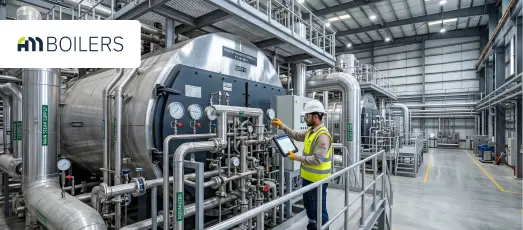
Boiler refractory is, in essence, a thermal liner protecting the boiler steel from the direct flame and heat; they retain shape, strength, and integrity at temperatures that would melt, warp, or soften normal metal.
They are typically made out of alumina, silica, and silicon carbide, and may take shape as bricks, poured castables, or fiber linings.
This refractory layer goes between the flame and pressure parts and does most of the work in resisting the heat so that steel can be prevented from being damaged. This layer resists heat and guides it to where it is required and constrains it from being damaging to the steel tube and casing.
A good refractory material in boiler service is under various stresses at the same time - not just one. The important properties are:
We might think of refractory only in terms of shielding steel, but the lining does a little more for your boiler than simply protecting the steel walls.
The lining traps the heat in the combustion chamber so that the boiler can operate effectively. A good refractory liner will produce more steam using fuel than letting fuel escape out of the walls.
The tubes, walls, headers, etc. that make up pressure parts are not designed to be in direct contact with a flame. The refractories prevent this local overheating that causes tube bulging, weld cracks, and early equipment failure.
No boiler is ever still. A boiler warms up and cools down; cycles with load; and vibrates. A good lining absorbs this movement and stress, not failing by cracking or pulling apart. Thus, it protects for years at normal service conditions.
Stable refractory leads to fewer chances of hot spots on the shell, fewer leaks, fewer forced outages, and a lower probability of a sudden trip during operation. That is the whole purpose when it is used in marine or industrial plants where downtime is expensive, and safety is absolute.
No single product can serve the needs of all boilers or zones. The application of each depends on temperature, wear and tear, chemistry, and shape:
Fire bricks, made of mainly alumina and silica, are solid pre-formed shapes and support a high heat as well as structural load, so they are always the preferred choice for walls in furnaces, etc. In terms of refractory material for boiler walls, they are heavy and are slow in installation.
Higher alumina content, in turn, increases thermal capacity and resistance to chemical attack. High alumina refractories are ideal for the most extreme zones, for example, in areas near a burner. They are more expensive than fire clay products but are economical if correctly positioned.
Castables are monolithic materials which are mixed with water and cast, pumped or sprayed into place, similarly to concrete. They have flexibility in forming complex shapes, making them useful for repairs and areas where brickwork is inappropriate.
Insulating castables are lightweight and lower-density alternatives that are designed for low heat conductivity rather than direct exposure to the flame. They are located behind the hot face and are intended to hold the heat within the system, ensuring the outer part is cooler.
These are rigid, putty-like substances that are rammed or hand-packed into place. They excel in repairs and awkward geometries where pouring castable or laying brick is not feasible.
With good abrasion resistance and thermal shock resistance, silicon carbide is ideally suited for areas requiring the highest wear and heat. A classic example is the CFB boiler cyclone, where the rapid movement of particles would wear through lesser materials.
It is available in modules, boards, and blankets. Ceramic fiber products provide highly efficient insulation and low thermal mass, resulting in quicker and smoother heating and cooling cycles. It is intended for use as lining or insulation, not in load-bearing or highly abrasive areas.
| Material Type | Temp Range | Main Benefit | Typical Application |
|---|---|---|---|
| Fire Bricks | Up to 1500°C | Structural strength | Furnace walls |
| High Alumina | Up to 1800°C | High refractoriness | Burner zones |
| Castables | 1300 to 1600°C | Easy to install in complex shapes | Repairs, irregular surfaces |
| Insulating Castables | Up to 1200°C | Heat retention | Backup insulation layers |
| Plastic / Moldable | Up to 1600°C | Moldable for repairs | Patching, tight spots |
| Silicon Carbide | Up to 1700°C | Abrasion and shock resistance | High-wear zones, CFB cyclones |
| Ceramic Fiber | Up to 1400°C | Lightweight insulation | Linings, ducting, insulation |
Refractory is not put on to the boiler all at the same thickness. At points where it is most subject to the stresses of heat, wearing away, and chemical corrosion, the refractory layer will be very thick, and different types of refractories will be used.
This is the hottest section in the boiler and therefore requires the thickest and most heat-resistant lining. This refractory supports the flame and the steel behind it, and stops the combustion temperature from getting outside of the refractory lining.
In circulating fluidized bed boilers, there is constant striking of particles at very high speed, which requires abrasion-resistant material. Hence, silicon carbide and highly wear-resistant castables are used.
The ash hoppers receive continual abrasion from often corrosive ash. A robust abrasion resistance to prevent the lining from being worn down to expose the steel is required.
These extensive surfaces are lined mostly for the retention of heat and the protection of structures. They last the longest in the entire boiler since they are not directly exposed to flame or abrasive conditions.
Burner zones receive direct flame and intense high temperatures. They are subject to the harshest environments and thus require high-grade refractories, most commonly high alumina.
Ducting and expansion joints transport hot gas and also need to allow for expansion as the temperature changes. Linings in this part of the system offer resistance to heat and abrasion.
Fuel is a critical deciding factor in material selection. A refractory that performs very well in a clean-burning gas boiler may be rapidly destroyed in a biomass or waste furnace due to an aggressive chemical environment.
Coal produces heavy ash and slag, so these boilers need linings that resist both abrasion and chemical attack. High alumina refractories and silicon carbide are common choices for the most exposed zones.
The alkalis released from biomass fuels attack many refractories with high intensity. Against these alkali attacks, as well as the wear provided by biomass ash, the SiC and the dense castables are stronger.
Extreme abrasion is the primary problem to deal with in CFB units. Abrasion-resistant castables and silicon carbide seem to be the materials that endure this constant particle erosion.
If the mixed waste is being burned, the lining will then be attacked by chlorides and various chemicals. Corrosion-resistant castables are needed in this instance.
Because the boilers burn so cleanly, less chemical attack and less wear due to abrasion occur. The most important need here is to withstand thermal cycling, which dense castables and ceramic fiber are well capable of.
| Boiler Type | Recommended Refractory | Key Reason |
|---|---|---|
| Coal-Fired | High alumina + silicon carbide | Slag and abrasion resistance |
| Biomass | Silicon carbide + dense castables | Alkali and abrasion resistance |
| CFB | Abrasion-resistant castables + SiC | Extreme cyclone wear |
| Waste-to-Energy | Corrosion-resistant castables | Chloride and chemical resistance |
| Oil and Gas | Dense castables + ceramic fiber | Thermal cycling |
The service life of a lining is affected by the lining material, its location in the fire zone, and its installation and operation procedures.
The type of material provides a starting point. Heavy structural materials will last a much longer time than light insulating materials, and silicon carbide is on the hard side.
| Refractory Type | Expected Lifespan |
|---|---|
| Fire Bricks | 10 to 20 Years |
| Castables | 3 to 5 Years |
| Insulating Refractories | 2 to 5 Years |
| Silicon Carbide | 5 to 10+ Years |
It's not just what it is made of; it's where the lining is located as well. The more extreme the area, the quicker the lifespan. This explains why cyclones and ash hoppers have to be looked at so much more regularly than walls and roofs.
| Boiler Area | Typical Lifespan |
|---|---|
| Cyclones | 1 to 3 Years |
| Ash Hoppers | 1 to 3 Years |
| Combustion Chambers | 3 to 5 Years |
| Walls & Roofs | 10 to 20+ Years |
Several conditions can cut these numbers short. Alkali attack, erosion, wear (abrasion or thermal shock), corrosion (sulfur attack) on the operating face, or failure from installation and curing defects on the backing face will shorten life.
While nearly all such premature failures are caused by one or more of these, most of these factors can be controlled by the right material selection and operating procedure.
If a liner fails prematurely, it's usually easy to find out why. Here's a rundown of what the common problems are and how you can identify them before it causes a shutdown.
The rapid change in temperature causes the surface to expand and contract at different rates. This results in cracking and flaking of the hot face. Proper controlled heating and cooling is the primary defense against this.
Wear by abrasive ash and high-velocity gas continuously occurs in cyclones and ash hoppers. As the refractory thickness is gradually reduced by wear, it exposes the steel casing.
Alkalis, sulphur and chlorides within the fuel and flue gas react with the refractory and lead to erosion over time. This is a key problem within biomass and waste-to-energy boilers where fuel chemistry is severe.
Hot molten ash deposits can form on the hot face, which reacts with and damages the material behind it. The effects of slagging include damage to the lining and to the heat transfer.
This new castable lining contains moisture that needs to be slowly dried off on the first heating up. If this is done too fast, the steam is trapped inside, and it can crack/spall off. Failure to dry out is the most avoidable common cause.
Low-quality workmanship (incorrect mixing, loose anchor, quick installation, etc.) builds up initial weaknesses that tend to fail early under thermal and mechanical load, irrespective of material quality.
Problems with refractory almost always have signs before an emergency occurs. A proactive repair as opposed to an emergency repair can be detected.
Surface cracking represents the most immediate sign of lining failure. Fine cracking can be monitored or repaired by patching; any deep or growing crack must be investigated quickly.
If the outer casing becomes much hotter than expected, there must be a break in the liner or thin section, allowing heat to escape. These "hot spots" represent a loss of efficiency and a safety hazard.
When inspecting, the loose or fallen-off material is a definite sign that the lining is failing and presents a risk of debris damage to other components.
When your boiler is using more fuel to produce a similar output, it's highly probable the reason is failing refractories allowing heat to escape. Increased fuel use is typically the first indicator.
Frequent unplanned shutdowns may result from the lining failing due to hot spots, overheating, and subsequent damage. It is likely to be related to the refractory and should be investigated.
Learn More: Top Warning Signs Your Boiler Needs Immediate Servicing in UAE
Most factors linked to lining failure are avoidable. A few consistent practices can extend the service life and defer your next reline.
The initial choice of material, suitable for fuel, temperature, and zone, will make or break the situation. An incorrect material in a stressed zone cannot be saved by careful maintenance.
Proper mixing, anchoring, and application by an experienced installer eliminates the areas of weakness that will fail prematurely.
Small, controlled changes in temperature help prevent thermal shock and dry out new linings safely, which is the easiest way to extend your refractory life.
Regular checks find the minor cracks, wear, and thinning before it becomes major; by performing planned inspections, surprise failures become planned repairs.
By monitoring temperatures within the shell, fuel consumed, and the inspection history, you can predict the next maintenance requirement for a zone and plan accordingly.
A small patch when detected prevents it from developing into a full lining failure. A minor patch during planned downtime is a cheaper option than an emergency reline.
Industrial and energy needs drive the use of these materials. A brief overview of the boiler refractory market will clarify the general direction of technology.
With companies trying to save money by burning less fuel, there's also a greater demand for better linings to hold the heat in longer.
Main sectors driving demand are power generation, marine, oil and gas, chemical processing, waste to energy.
Recent formulations address longer life, speed of installation, and enhanced chemical and abrasion resistance.
There is an increasing demand for long-lasting materials with a reduced amount of waste, and for machinery with lower-emission operation.
It goes without saying that the best material will only perform if correctly specified, sourced and fitted. It is these factors which are important to assess when judging a boiler refractory material supplier.
Check for products with proper test data and standards associated with them. Tested quality makes for a liner that doesn't wear out within one year.
A supplier who knows boilers well would know what material to put where. That is the kind of knowledge that can save you from putting the wrong material in the wrong spot.
When you buy your material from the same supplier that installs and maintains it, there is only one point of contact to assign it to.
A good supplier will advise on selection, design, operation – not simply place the order. The advice given can sometimes be of the highest value, especially for difficult zones.
Each boiler has a geometry, fuel type, and operational profile that is unique. It is always beneficial to source from a supplier that can offer customized solutions to your system.
With over two decades of hands-on experience across marine and industrial boiler systems, Almufaddal Boiler delivers reliable and practical refractory solutions based on real operating conditions. Our expertise covers marine, power generation, oil & gas, and process industries, allowing us to recommend the right refractory materials and methods for every application.
We offer end-to-end boiler refractory solutions, including:
Our dedicated refractory and insulation crews handle everything from new installations to emergency repairs. Supported by IACS class-approved welders and highly qualified technicians, we ensure consistent quality, safety, and workmanship on every project.
Every boiler operates under unique fuel, temperature, and process conditions. We assess each system individually to provide refractory solutions that maximize performance, reliability, and service life.
With service coverage across Dubai, Fujairah, and Bahrain, our team responds quickly to inspection, maintenance, repair, and replacement requirements, helping minimize downtime and operational disruptions.
For professional boiler refractory installation, boiler refractory repair, or boiler refractory replacement services, contact Almufaddal Boiler today for expert guidance and dependable support.

Your choice of boiler refractory material isn't just a minor technical decision. It affects boiler burning efficiency, safety, and the frequency and duration of expensive downtime. The material choice is important, but so are all the related factors: correct installation, regulated operation, thorough inspections, and timely repairs; all of which will determine if the lining lasts its full intended life or if it dies prematurely.
Best boilers are those in which refractory is designed and maintained as an element of the system. If there is doubt, contact refractory experts as soon as possible before the lining fails.

