2026-02-20
Compact and practical, they’ve become one of the most cost-effective tools for heat recovery. Boiler economizers stop that excess heat from slipping away and put it back to work. The payoff is straightforward: less fuel going up in smoke, boilers that run smoother day after day, and equipment that doesn’t grind down as fast as it used to. Whether it’s heavy industry in Dubai, a packaging line in Sharjah, or marine engines in Fujairah, these units are now central to boiler system optimization in the UAE.
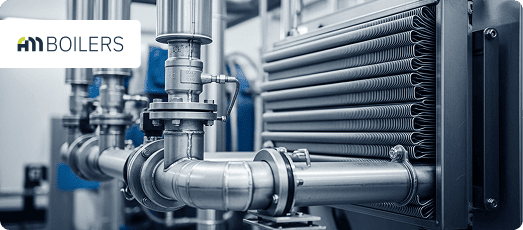
A boiler economizer works as a heat exchanger, though the idea behind it is straightforward. It simply takes the heat from the flue gases and passes it into the feedwater heading into the boiler.The boiler doesn’t need as much fuel to bring it up to temperature, as the water goes in warmer. This leads to cutting down on operating costs.
When it comes to industrial boiler economizers, the setup can look different depending on the boiler type, the fuel that you are burning, and how you are using the system. But the main idea stays the same, use what would be lost and turn it into something useful. Yet the foundation doesn’t change: capture wasted heat and turn it back into usable energy.
Fuel efficiency means more than lower bills, it’s tied directly to staying competitive. In heavy energy sectors like cement, power generation, petrochemicals, and marine transport, even minor gains in efficiency can cut annual fuel use by staggering amounts.
There’s also the environmental angle. Economizers form part of industrial heat recovery systems that limit greenhouse gas emissions, giving companies a way to align with regulations and sustainability targets. In shipping, where fuel costs dominate, an economizer often decides whether a voyage runs at profit or loss.
A boiler economizer isn’t just a piece of hardware bolted onto a system, it’s there for a reason, actually three reasons. The first is preheating the feedwater. When the water is warmer before it even enters the boiler, the amount of energy needed to turn it into steam drops noticeably. The second is efficiency. Lowering the flue gas temperature means less fuel goes to waste, and that directly reduces operating costs. The third reason is longevity. With reduced thermal stress and fewer chances for corrosion, the equipment simply lasts longer.
The working idea is pretty straightforward, even though the outcome makes a big difference. The flue gases leaving the boiler still carry plenty of heat, and rather than wasting it, that heat is directed across the economizer tubes. At the same time, cooler feedwater runs through those tubes in reverse flow. As the two streams cross paths, heat shifts from gas to water, raising the water temperature before it reaches the boiler.
The result is a system that squeezes more efficiency from the same fuel. And in some of the more advanced boiler economizer heat recovery systems, that recovered heat doesn’t just go back into feedwater, it can also be redirected for other tasks, like warming parts of a building or preheating the combustion air itself.
Economizers come in different forms depending on design and purpose:
A boiler economizer contributes to performance in several important ways, as listed below:
All of these benefits together make the boiler easier to run, help it last longer, and keep performance steady over time.
Economizers are now a standard across:
Adding a boiler economizer to a system delivers several clear advantages:
Altogether, these benefits make boiler economizers a practical choice for cutting costs while improving long-term performance.
Getting the most out of it starts with a successful boiler economizer installation. The unit has to be sized correctly for the system, built with materials that can handle the operating conditions, and carefully tied into the existing setup. In places such as the UAE, where industries deal with
extreme heat and strict regulatory standards, professional installation isn’t just recommended, it’s essential.
Boiler economizer maintenance includes:
Preventive maintenance is particularly important for economizer installation, IGG repair services, and incinerator services for marine and industrial boilers in Dubai, where these systems often run under demanding conditions.
When choosing an economizer, decision makers should evaluate:
By weighing these factors carefully, operators can match the economizer to their system’s needs and ensure dependable performance over the long run.
Economizers are changing and quickly. Today’s designs show:
All of this shifts boiler economizer performance monitoring toward greater accuracy, letting operators schedule service before breakdowns rather than scrambling afterward.
In the UAE, Al Mufaddal Boilers is recognized for dependable boiler maintenance and repair services. The team handles end-to-end economizer services for marine and industrial boilers, managing everything from fresh installations to urgent repair work.
Some of the core services they carry out include:
For companies seeking boiler repair in UAE or specialized economizer install, repair and maintenance, Al Mufaddal Boilers delivers the technical knowledge and reliability needed to keep operations running smoothly.

Industrial boilers keep many operations running, but there’s a catch, without economizers, a lot of energy slips away unused. Economizers step in by grabbing that leftover heat instead of letting it disappear through the stack. The result: lower fuel bills, better efficiency, and a push toward more sustainable operations.
For industries across the UAE, the decision isn’t whether to adopt economizers, it’s who to trust with their installation and upkeep. With a proven track record in economizer install, repair and maintenance services in Dubai, Al Mufaddal Boilers ensures that every system operates at peak efficiency with minimal downtime.
Yes, we custom-build metallic expansion joints and bellows designed to handle exhaust gases, steam, condensate water, and LPG applications. Whether it's for compact setups or large-scale systems, we offer sizes ranging from 100 mm to 5000 mm in diameter, all built for flexibility, durability, and long-term reliability in demanding environments.

